


Kaiyo
| Country | Japan |
| Ship Class | Kaiyo-Class Escort Carrier |
| Builder | Mitsubishi Nagasaki Shipyard |
| Laid Down Date | 5 Feb 1938 |
| Launch Date | 9 Dec 1938 |
| Commission Date | 23 Nov 1943 |
| Sunk Date | 24 Jul 1945 |
| Displacement | 13,600 tons standard; 16,483 tons full |
| Length | 546 feet |
| Beam | 72 feet |
| Draft | 26 feet |
| Machinery | 4 water-tube boilers, 2 Kampon geared steam turbines, 2 shafts |
| Power Output | 52,100 shaft horsepower |
| Speed | 23 knots |
| Range | 7,000nm at 18 knots |
| Crew | 829 |
| Armament | 4x2x12.7cm/40 Type 89 dual-purpose guns, 8x3x25mm Type 96 anti-aircraft guns |
| Aircraft | 24 operational, 0 in reserve |
| Recommissioned | 23 Nov 1943 |
| Flight Deck | 160x23m |
Contributor: C. Peter Chen
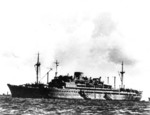
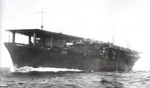
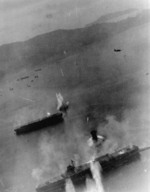
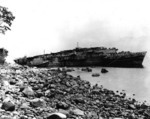
ww2dbasePassenger liner Argentina Maru of Mitsui O.S.K. Lines, Ltd. was launched in 1938 and ran passenger routes between Japan and South America. On 9 Dec 1942, she was purchased by the Japanese Navy to be converted to become an escort carrier as the direct result of the Midway debacle. She was converted at the Nagasaki Shipyard in Japan by Mitsubishi Heavy Industries between 10 Dec 1942 and 23 Nov 1943. The newly converted Kaiyo received destroyer type turbines (removing her passenger ship diesel engines) and was equipped with facilities to operate 24 aircraft. She served largely as an aircraft ferry. On 19 Mar 1945, while moored at Kure, Japan, she was damaged during an American air raid, causing some flooding. On 10 Apr, she participated in a training exercise with the Combined Fleet in Beppu Bay, Japan. On 24 Jul, she hit a naval mine. On the next day, her crew grounded her off Hinode, Japan in Beppu Bay due to the inability to stem flooding. On 28 Jul, she was attacked by aircraft possibly from USS Essex and was hit by either a rocket or a bomb that disabled her electric generator; 20 men were killed and the flooding problem became worse. On 29 Jul, United States Army Air Force B-25 Mitchell bombers attacked her, followed by carrier aircraft from USS Ticonderoga. Later that day, a medical doctor convinced Kaiyo's commanding officer Captain Shuichi Osuga to abandon the repair efforts due to the unhealthy conditions (lack of power meant the ship was not ventilated at all). Osuga gave the order to coat the machinery with oil and then flood the boilers, hoping to preserve the ship while keeping her stable on the shallow bay floor. On 9 Aug, she was attacked by 12 USAAF B-25 bombers again; one of the attackers caught a wing tip on Kaiyo's camouflage tree limbs and netting and crashed into the bay. This would be the last time the ship's anti-aircraft weapons were manned. After the war, she was raised in 1946 by Nissan Salvage. She was towed closer to shore and then scrapped between 1 Sep 1946 and 31 Jan 1948.
ww2dbaseSources: Nihon Kaigun, Wikipedia.
Last Major Revision: Apr 2009
Escort Carrier Kaiyo Interactive Map
Photographs
 |  |  |  |
Kaiyo Operational Timeline
| 23 Nov 1943 | Kaiyo was commissioned into service. |
| 26 Dec 1944 | Escort carrier Kaiyo, Patrol Boat No. 102, minelayer Niizaki, escort vessel Okinawa, escort vessel Type C No. 25, escort vessel Type C No. 207, and escort vessel Type C No. 63 departed Singapore at 1158 hours to escort convoy HI-84 consisted of transport Ikutagawa Maru, transport Awa Maru, tanker Akashi Maru, tanker Toa Maruk tanker Amato Maru, tanker Ryoei Maru, and tanker Miri Maru; Awa Maru also carried about 525 British, American, and Australia prisoners of war. |
| 29 Dec 1944 | Japanese convoy HI-84 arrived at Cap Saint-Jacques, Cochinchina at 1157 hours and departed at 1625 hours. Tanker Akashi Maru and transport Ikutagawa Maru remained at Cap Saint-Jacques, while the escort force gained escort vessels Type C No. 27 and Type D No. 34. |
| 30 Dec 1944 | Japanese convoy HI-84 sailed past battleship-carrier Ise, battleship-carrier Hyuga, cruiser Oyodo, cruiser Ashigara, destroyer Asashimo, and destroyer Kasumi in the South China Sea in the morning. At 1157 hours, HI-84 arrived at Binhoang Bay, French Indochina. |
| 31 Dec 1944 | Japanese convoy HI-84 departed Binhoang Bay, French Indochina at 0745 hours. At about 1000 hours near the coast of Tuy Hoa, Annam, French Indochina, USS Dace fired 3 torpedoes at carrier Kaiyo, with all torpedoes missing. The Japanese were not aware of the attack. At 1804 hours, HI-84 arrived at Quy Nhon, Annam. |
| 1 Jan 1945 | Japanese convoy HI-84 departed Quy Nhon, Annam, French Indochina at 0057 hours. |
| 2 Jan 1945 | Japanese convoy HI-84 arrived at Tourane, Annam, French Indochina at 0105 hours. |
| 3 Jan 1945 | Japanese convoy HI-84 departed Tourane, Annam, French Indochina at 0755 hours. While sailing south of Hainan, China, tanker Miri Maru struck a mine and suffered flooding in her engine room; the tanker was detached from the convoy to sail to Hong Kong at a slow speed. |
| 5 Jan 1945 | Japanese convoy HI-84 arrived at Hong Kong at 1840 hours and departed at 1937 hours. |
| 9 Jan 1945 | Japanese convoy HI-84 arrived at Zhoushan archipelago, Zhejiang, China near Shanghai at 1120 hours. |
| 10 Jan 1945 | Japanese convoy HI-84 departed Zhoushan archipelago, Zhejiang, China at 0720 hours. |
| 13 Jan 1945 | Japanese convoy HI-84 arrived at Moji, Fukuoka, Japan at 1725 hours. |
| 24 Jul 1945 | British TF 37 launched 416 sorties, 261 of which were sent against the Japanese home islands and 155 were for defensive patrols; escort carrier Kaiyo was damaged by British carrier planes. On the same day, American TF 38 launched 600 aircraft against Kure, Nagoya, Osaka, and Miho, sinking battleship-carrier Hyuga, heavy cruiser Tone, and target ship Settsu, and damaging carrier Ryuho, carrier Amagi, battleship-carrier Ise, battleship Haruna, heavy cruiser Aoba, light cruiser Oyodo, transport Kiyokawa Maru; the Aichi aircraft factories at Nagoya were seriously damaged. |
| 29 Jul 1945 | B-25 bombers of US 5th Air Force damaged Japanese escort carrier Kaiyo at Hiji, Japan. |
Please consider supporting us on Patreon. Even $1 per month will go a long way! Thank you. Please help us spread the word: Stay updated with WW2DB: |


Visitor Submitted Comments
All visitor submitted comments are opinions of those making the submissions and do not reflect views of WW2DB.

» Dutch East Indies Campaign, Java
» Preparations for Invasion of Japan
Document(s):
» Japanese Aircraft Carrier Functions
» Japanese Aircraft Carrier Operational Status By Month
» Japanese Aircraft Carrier Specifications
» Japanese Aircraft Carrier Time Operational
Partner Sites Content:
» Kaiyo Tabular Record of Movement
- » 1,182 biographies
- » 337 events
- » 45,119 timeline entries
- » 1,248 ships
- » 350 aircraft models
- » 207 vehicle models
- » 376 weapon models
- » 123 historical documents
- » 261 facilities
- » 470 book reviews
- » 28,410 photos
- » 365 maps
George Patton, 31 May 1944

Please consider supporting us on Patreon. Even $1 a month will go a long way. Thank you!

Or, please support us by purchasing some WW2DB merchandise at TeeSpring, Thank you!
25 May 2009 10:23:53 PM
aq pgen tau tmpt beroperasix kpal tug boat jenis kaiyo st 1224 c d singapore