


Ryujo
| Country | Japan |
| Ship Class | Ryujo-class Aircraft Carrier |
| Builder | Mitsubishi, Yokohama Dockyard |
| Laid Down | 26 Nov 1929 |
| Launched | 2 Apr 1931 |
| Commissioned | 9 May 1933 |
| Sunk | 24 Aug 1942 |
| Displacement | 10,600 tons standard; 12,732 tons full |
| Length | 590 feet |
| Beam | 68 feet |
| Draft | 23 feet |
| Machinery | 12 Kampon water-tube boilers, 2 geared steam turbines, 2 shafts |
| Power Output | 65,000 shaft horsepower |
| Speed | 29 knots |
| Range | 10,000nm at 14 knots |
| Crew | 934 |
| Armament | 4x2x12.7 dual-purpose guns, 2x2x25mm anti-aircraft guns |
| Aircraft | 48 operational, 0 in reserve |
Contributor: C. Peter Chen
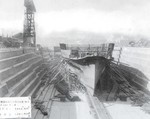
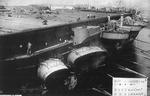
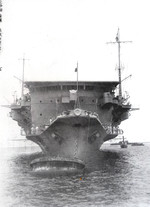
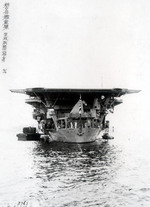
ww2dbaseRyujo was laid down as an 8,000 ton carrier in 1929. When she was completed, it was discovered that her design was not capable to safely travel in the rough seas. In the mid-1930s and 1940 she was reconstructed to improve her sea-worthiness. Her construction was unique that her forecastle was built within the hangar structure, giving her a clean and streamlined look.
ww2dbaseRyujo's first WW2 service came in 1937 during the Second Sino-Japanese War. When the Pacific War began, she was commanded by Captain Tadao Kato as the flagship of Carrier Division 4. She was constructed as a fleet carrier, but her relative small size prevented her from being used effectively as one, so her role was relegated to a supporting one alongside of other larger and more modern fleet carriers. In Dec 1941, she provided air support for the landings at Davao and Jolo. In Jan 1941 she supported operations in Malaya. In Feb 1942, she fought at the Battle of the Java Sea, assisting in sinking the American destroyer Pope. In Apr 1942 she also participated in the Japanese Navy's raid into the Indian Ocean; she launched aircraft against Cocanada and Vizagapatam in India. On 3 and 4 Jun 1942, she participated in Operation AL to attack and occupy the Aleutian Islands in the North Pacific.
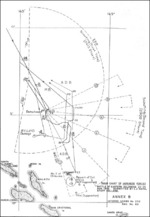
ww2dbaseIn Aug 1942, Ryujo was sent as a bait for American air attacks while the main force attacked the American carriers; what resulted was the 24 Aug Battle of the Eastern Solomons. The bait Ryujo was overwhelmed and was eventually hit by several 1,000-lb bombs then subsequently one hit by aerial torpedo. She listed 20 degrees to port, then a moment later her engines stopped. Captain Kato ordered abandon ship at 1315. All but 120 of her crew were removed by the flagship cruiser Tone and destroyers Amatsukaze and Tokitsukaze; her aircraft were sent to Buka Island. At 2000 that day she sank under the waves. Only one American aircraft was lost during the attack on her.
ww2dbaseSources: Naval Historical Center, the Struggle for Guadalcanal, Wikipedia
Last Major Revision: Mar 2006
Aircraft Carrier Ryujo Interactive Map
Photographs
 |  |  |  |
Maps
 |
Ryujo Operational Timeline
| 9 May 1933 | Ryujo was commissioned into service. |
| 5 Sep 1937 | Ryujo departed Sasebo, Japan. |
| 21 Sep 1937 | Ryujo attacked Guangzhou, Guangdong, China with 9 aircraft in the afternoon; they claimed to have shot down five of the defending Chinese Hawk III fighters. |
| 3 Oct 1937 | Ryujo arrived at Shanghai, China. |
| 6 Dec 1941 | Ryujo departed Palau Islands for the Philippine Islands. |
| 1 Apr 1942 | Vice Admiral Jisaburo Ozawa's Malaya Force, Second Expeditionary Fleet, departs Mergui, Burma and steams into the Bay of Bengal in the Indian Ocean Raids to attack merchant shipping. The force includes light carrier Ryujo and cruisers Chokai, Suzuya, Kumano, Mikuma, Mogami, and Yura. |
| 5 Apr 1942 | Following Admiral Jisaburo Ozawa’s force’s attack on the British naval base at Colombo, Ceylon, the force is split creating a Northern Group commanded by Rear Admiral Takeo Kurita consisting of cruisers Kumano and Suzuya; the Center Group consisting of the carrier Ryujo and cruisers Chokai and Yura under Ozawa; and the Southern Group comprised of cruisers Mogami, and Mikuma under Captain Shakao Sakiyama for the purposes of smaller raids against merchant shipping. |
| 11 Apr 1942 | Jisaburo Ozawa's Force arrived at Singapore to conclude a successful sortie into the Indian Ocean. |
| 28 Jun 1942 | No. 2 Striking Force of the Japanese Navy 1st Air Fleet (Junyo, Ryujo, Zuiho, and Zuikaku) departed Ominato Guard District in Mutsu, Aomori Prefecture, Japan to patrol waters south of Kiska of Aleutian Islands. |
| 6 Jul 1942 | No. 2 Striking Force of the Japanese Navy 1st Air Fleet (Junyo, Ryujo, Zuiho, and Zuikaku) departed waters near Kiska, Aleutian Islands. |
| 24 Aug 1942 | A Japanese force centered around carriers Shokaku and Zuikaku sailed down into the Solomon Islands with light carrier Ryujo and cruiser tone operating independently south of the main fleet. At 0415, 19 torpedo bombers and 7 seaplanes were launched to search for American ships. At 1250, the search plane from cruiser Chikuma reported sighting USS Saratoga and USS Enterprise; the search plane was quickly shot down, but the Japanese nevertheless gained an idea of the American position. Shokaku launched 18 dive bombers and Zuikaku launched 9 dive bombers starting at 1300 hours. At 1315, two bombers from Enterprise surprised Shokaku, but the torpedo they launched would fail to hit the Japanese carrier. At 1400 hours, a second strike was launched by Shokaku (9 dive bombers and 3 fighters) and Zuikaku (18 dive bombers and 6 fighters). At around the same time, Battle of the Eastern Solomons crew its first casualty when Ryujo was discovered and fatally damaged by several 1,000-pound bombs. At 1440, the first attack wave from the Japanese carriers attacked Enterprise, scoring three bomb hits (70 were killed, 70 were injured), but the Japanese would lose 18 dive bombers and 6 fighters in the engagement. The second wave failed to locate the American carriers and returned before dark. Japanese warships attempted to engage the US fleet after dark, but the force failed to locate the American fleet, and discontinued the search at 2330 hours. |
Please consider supporting us on Patreon. Even $1 per month will go a long way! Thank you. Please help us spread the word: Stay updated with WW2DB: |


» Kaneko, Tadashi
» Kondo, Masaichi
» Okumiya, Masatake
Event(s) Participated:
» Second Battle of Shanghai
» Guangdong Operation
» Invasion of the Philippine Islands
» Invasion of Malaya and Singapore
» Dutch East Indies Campaign, Java
» Dutch East Indies Campaign, Sumatra
» Fall of the Andaman and Nicobar Islands
» Battle of Midway and the Aleutian Islands
» Solomon Islands Campaign
Document(s):
» Japanese Aircraft Carrier Functions
» Japanese Aircraft Carrier Operational Status By Month
» Japanese Aircraft Carrier Specifications
» Japanese Aircraft Carrier Time Operational
Partner Sites Content:
» Ryujo Tabular Record of Movement
- » 1,176 biographies
- » 337 events
- » 44,927 timeline entries
- » 1,245 ships
- » 350 aircraft models
- » 207 vehicle models
- » 376 weapon models
- » 123 historical documents
- » 261 facilities
- » 470 book reviews
- » 28,467 photos
- » 365 maps
General Douglas MacArthur at Leyte, 17 Oct 1944

Please consider supporting us on Patreon. Even $1 a month will go a long way. Thank you!

Or, please support us by purchasing some WW2DB merchandise at TeeSpring, Thank you!