


Kaga
| Country | Japan |
| Ship Class | Kaga-Class Aircraft Carrier |
| Builder | Yokosuka Naval Arsenal |
| Laid Down Date | 19 Jul 1920 |
| Launch Date | 17 Nov 1921 |
| Commission Date | 1 Nov 1929 |
| Sunk Date | 4 Jun 1942 |
| Displacement | 38,200 tons standard; 42,541 tons full |
| Length | 812 feet |
| Beam | 107 feet |
| Draft | 31 feet |
| Machinery | Kanpon geared turbines, four screws |
| Bunkerage | 8,208t oil, 600t aviation fuel |
| Power Output | 127,400 shaft horsepower |
| Speed | 28 knots |
| Range | 10,000nm at 16 knots |
| Crew | 1,708 |
| Armament | 10x8in, 16x5in, 22x25mm anti-aircraft |
| Armor | 6in belt, 3.1in deck |
| Aircraft | 72 operational, 18 in reserve |
| Arrester Wires | 9 |
| Hangar Decks | 3 |
| Elevators | 3 |
Contributor: C. Peter Chen
ww2dbaseKaga was Japan's first heavy carrier, converted from a battleship due to be scrapped under the terms of the 1922 Washington Naval Treaty. She was built at Kobe and Yokosuka in Japan, launched in 1926, and reconstructed (extended the flight deck) in 1934-1935. While her speed was not top-notch, her tall flight deck provided a large and dry platform for takeoffs and landings, making it a welcoming home for her aircraft. She was active off China during the Sino-Japanese War, and was one of the main carriers that launched the planes that attacked Pearl Harbor.
ww2dbaseShe was lost at the Battle of Midway after being attacked by about thirty dive bombers. The first hit damaged the aft area of the flight deck, while the second crushed into the forward elevator, causing major damage below decks. By this point, Kaga had lost all her steering capabilities. Flight commander Takahisa Amagai was probably the luckiest of all senior officers at the bridge at that time, for that the next bomb probably landed close or squarely on it, and he was the only one who survived. The fourth and probably final hit landed amidships, but there was so much confusion that there could had been another. Amagi recalled:
ww2dbaseThe uncontrollable fire aboard Kaga could partly be attributed to Japanese carrier design of the time. According to plan, to fight fire in the enclosed hangar, the damage control team was to pull heavy fire curtains that were placed in the hangar designed to isolate. However, the fires occurring in multiple areas of the hangar made isolation impossible. Furthermore, a single water main running along the ship that supplied water for firefighting was destroyed when multiple bombs exploded near the lone water main. Finally, the hangar at the time was filled with ammunition; in this enclosed hangar, without an opening directly to the exterior, the crew simply had no way to move the heavy bombs and torpedoes away from the fires (only a few men remained alive in the hangar at this time, in any case). With aviation fuel continued flowing, there was no stopping of the conflagaration. Kaga's demise would have been just a bit quicker if American torpedoes were a bit more reliable: while Kaga was ablaze, USS Nautilus found the carrier and fired four torpedoes at her. The first was stuck in the tube, while the second and the third missed widely. The fourth hit Kaga squarely, scaring the swimming sailors near by, but it failed to detonate. Ironically, the torpedo broke in half and provided floatation tools for the Japanese sailors.
ww2dbaseThe crew of Kaga removed the Emperor's portrait at 1325 as it was determined that the carrier was now beyond repair, though gallant efforts to keep her alive continued for several more hours. By 1640, the order to abandon ship was finally given. At 1925, the escorting destroyer Hagikaze launched two torpedoes at the carrier after rescuing all the remaining survivors. A minute later, both 1,000-pound warheads hit Kaga's starboard side amidships. Commander Seiji Nakasugi stood on the deck of Hagikaze and witnessed his ship's last moment; "it was a horrendous sight to see a huge warship like this vanish. But she went nobly." At 1925, she went completely under the waves. Amagai lamented "I should have died with her".
ww2dbasePart of Kaga's wreck was discovered in Sep 1999 by a team that included members of Nihon Kaigun website (http://www.combinedfleet.com). The wreckage, laying 17,000 feet below the surface, consists of two gun tubs and a section of the upper hanger deck, located on the starboard aft machine-gun gallery of Kaga. For more information, please see the original article at Combinedfleet.com.
ww2dbaseSource: Imperial Japanese Navy Page, Midway Dauntless Victory, the Pacific Campaign, Shattered Sword, US Navy Naval Historical Center.
Last Major Revision: Sep 2008
Aircraft Carrier Kaga Interactive Map
Photographs
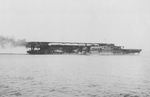 | 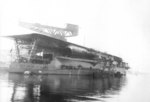 | 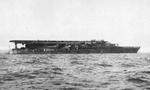 | 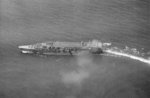 |
Kaga Operational Timeline
| 1 Nov 1929 | The conversion of a Tosa-class battleship hull to a fleet carrier completed at Sasebo Naval Arsenal, Japan. She was commissioned into Japanese Navy service as Kaga. In her original configuration, she sported three flight decks that form a series of ramps at the bow. |
| 4 Oct 1937 | Kaga departed Sasebo, Japan. |
| 7 Oct 1937 | Kaga arrived off Guangdong Province, China. |
| 24 Oct 1937 | Kaga departed waters south of Guangdong Province, China. |
| 11 Nov 1937 | Billy MacDonald, flying a Chinese Air Force P-26 fighter, discovered Japanese carrier Kaga near Zhoushan Island, Zhejiang Province, China. Three Gamma bombers of Chinese 2nd Bombardment Group came in to attack, but all bombs landed in the carrier's wake, causing no damage. A5M fighters from Kaga shot down two of the Chinese bombers. |
| 21 Nov 1937 | Kaga departed Sasebo, Japan. |
| 24 Nov 1937 | Kaga arrived off Guangdong Province, China and began launching aircraft against Chinese positions near Guangzhou. |
| 29 Nov 1937 | Kaga departed waters south of Guangdong Province, China; some of her aircraft were left behind to operate from airfields in southern China. |
| 10 Dec 1937 | Kaga departed Sasebo, Japan. |
| 14 Dec 1937 | Kaga arrived off Guangdong Province, China. |
| 28 Feb 1938 | Kaga departed Yokosuka, Japan. |
| 3 Mar 1938 | Kaga arrived off Guangdong Province, China. |
| 4 Apr 1938 | While off Guangdong Province, China, Kaga's aircraft which had detached from the carrier in late 1937 were reassigned back to her. |
| 13 Apr 1938 | Kaga launched 18 D1A2 bombers at 0830 hours, with 6 fighters in escort, to attack Tienhe airfield near Guangzhou, Guangdong Province, China; Gladiator fighters of Chinese 28th Pursuit Squadron and 29th Pursuit Squadron intercepted the group, shooting down 2 A4N1 fighters and 2 D1A2 bombers; 4 Chinese fighters were also lost in combat. |
| 11 Dec 1938 | Kaga arrived at Sasebo, Japan. |
| 15 Oct 1940 | Captain Sadayoshi Yamada was named the commanding officer of Kaga. |
| 10 Apr 1941 | Kaga was assigned to Carrier Division 1 of the Japanese Navy First Air Fleet. |
| 1 May 1941 | Kaga entered the drydocks at Sasebo, Japan. |
| 14 May 1941 | Kaga departed the drydocks at Sasebo, Japan. |
| 21 May 1941 | Kaga was made the flagship of Carrier Division 1 of the Japanese Navy First Air Fleet at Sasebo, Japan. |
| 21 Jun 1941 | Kaga departed Sasebo, Japan. |
| 1 Jul 1941 | Kaga arrived at Yokosuka, Japan. |
| 8 Jul 1941 | Kaga departed Yokosuka, Japan. |
| 11 Jul 1941 | Kaga arrived at Ariake Bay at Kyushu, Japan. |
| 15 Sep 1941 | Captain Jisaku Okada was named the commanding officer of Kaga. |
| 23 Oct 1941 | Kaga was relieved as the flagship of Carrier Division 1 of the Japanese Navy First Air Fleet. |
| 11 Nov 1941 | Kaga entered the drydocks at Sasebo Naval Shipyard, Japan. |
| 14 Nov 1941 | Kaga exited the drydocks at Sasebo Naval Shipyard, Japan. |
| 17 Nov 1941 | Kaga arrived at Saeki Bay off Oita, Japan and embarked 100 aerial torpedoes. |
| 19 Nov 1941 | Kaga departed Saeki Bay off Oita, Japan for Etorofu Island, Kurile Islands. |
| 22 Nov 1941 | Kaga arrived at Hitokappu Bay, Etorofu Island, Kurile Islands. |
| 26 Nov 1941 | Vice Admiral Chuichi Nagumo led the Japanese Carrier Division 1 (Akagi and Kaga), Carrier Division 2 (Hiryu and Soryu), Carrier Division 5 (Shokaku and Zuikaku), first section of Battleship Division 3 (Hiei and Kirishima), Cruiser Division 8 (Tone and Chikuma), Destroyer Squadron 1, Destroyer Squadron 17, and Destroyer Squadron 18 out of Hitokappu Bay in the Kurile Islands for the Hawaii Operation, the attack on the US Pacific Fleet at Pearl Harbor, US Territory of Hawaii. |
| 23 Dec 1941 | Akagi, Kaga, Shokaku, and Zuikaku arrived at Hashirajima island in Hiroshima Bay, Japan, along with escorts Shigure, Shiratsuyu, Ariake, and Yugure. |
| 9 Jan 1942 | Kaga departed Iwakuni, Japan. |
| 15 Jan 1942 | Kaga arrived at Truk, Caroline Islands. |
| 17 Jan 1942 | Kaga departed Truk, Caroline Islands. |
| 23 Jan 1942 | At 0230 hours, Japanese troops began landing on New Britain on three beachheads, two of which were defended, but in general the Japanese had little difficult overcoming the defenses. Carrier aircraft from Akagi, Kaga, and Zuikaku supported the invasion after dawn, enjoying air superiority thus losing only one pilot (Flight Petty Officer 2nd Class Isao Hiraishi) all day. As the troops entered and captured Rabaul, New Britain, Bismarck Islands, as reported by Tolai natives later, Japanese troops mutilated corpses of Australian troops with axes and bayonets. On the same day, Japanese troops including the No. 2 Maizuru Special Naval Landing Force delivered by Tenryu also landed at Kavieng, New Ireland. |
| 25 Jan 1942 | Kaga arrived at Truk, Caroline Islands. |
| 1 Feb 1942 | Akagi, Kaga, Zuikaku, Hiei, Kirishima, and Chikuma departed Truk, Caroline Islands in an attempt to catch the enemy carrier force that had attacked the Marshall Islands. They were escorted by destroyers Shiranuhi, Kasumi, and Urakaze. |
| 2 Feb 1942 | Kaga set sail for Palau Islands, Caroline Islands. |
| 8 Feb 1942 | Akagi, Kaga, and Zuikaku arrived at the Palau Islands, having abandoned the pursuit of the American fleet. |
| 9 Feb 1942 | Kaga accidentally hit a reef in the Palau Islands, Caroline Islands, damaging her bilges. |
| 15 Feb 1942 | Kaga departed Palau Islands, Caroline Islands. |
| 21 Feb 1942 | Kaga arrived at Staring Bay near Kendari, Celebes, Dutch East Indies. |
| 25 Feb 1942 | Kaga departed Staring Bay near Kendari, Celebes, Dutch East Indies. |
| 5 Mar 1942 | Kaga launched aircraft in support of operations in Tjilatjap in central Java, Dutch East Indies. |
| 11 Mar 1942 | Kaga arrived at Staring Bay near Kendari, Celebes, Dutch East Indies. |
| 15 Mar 1942 | Kaga departed Staring Bay near Kendari, Celebes, Dutch East Indies. |
| 22 Mar 1942 | Kaga arrived at Sasebo, Japan. |
| 27 Mar 1942 | Kaga entered the drydocks of Sasebo, Japan to repair the damage caused by striking reefs in the Palau Islands, Caroline Islands on 9 Feb 1942. |
| 4 May 1942 | Kaga exited the drydocks of Sasebo, Japan and departed for the Inland Sea to join Carrier Division 1. |
| 27 May 1942 | Kaga departed Hashirajima in Hiroshima Bay, Japan for Midway Atoll. |
| 4 Jun 1942 | Kaga was struck by at least four bombs during the Battle of Midway and suffered a great fire. She was scuttled at 1925 hours by two torpedoes from destroyer Hagikaze. 814 were killed in her loss. |
| 10 Aug 1942 | Kaga was removed from the Japanese Navy list. |
Please consider supporting us on Patreon. Even $1 per month will go a long way! Thank you. Please help us spread the word: Stay updated with WW2DB: |


Visitor Submitted Comments
28 Mar 2021 11:01:47 AM
on june 4, where did 90 warplanes land, after kaga was burning? cant land on kaga nor midway. cant go to other 3 also sunk. so how many warplanes
flew to other carriers and how many lost? yhznks.
All visitor submitted comments are opinions of those making the submissions and do not reflect views of WW2DB.

» Amagai, Takahisa
» Okada, Jisaku
» Onishi, Takijiro
Event(s) Participated:
» Second Battle of Shanghai
» Battle of Xiamen
» Guangdong Operation
» Attack on Pearl Harbor
» New Guinea-Papua Campaign, Phase 1, Bismarck Islands
» Battle of Midway and the Aleutian Islands
Document(s):
» Japanese Aircraft Carrier Functions
» Japanese Aircraft Carrier Operational Status By Month
» Japanese Aircraft Carrier Specifications
» Japanese Aircraft Carrier Time Operational
Partner Sites Content:
» Kaga Tabular Record of Movement
» Wreckage from Japanese aircraft carrier sunk at Battle of Midway identified!
- » 1,183 biographies
- » 337 events
- » 45,131 timeline entries
- » 1,249 ships
- » 350 aircraft models
- » 207 vehicle models
- » 376 weapon models
- » 123 historical documents
- » 261 facilities
- » 471 book reviews
- » 28,438 photos
- » 365 maps
General Douglas MacArthur at Leyte, 17 Oct 1944

Please consider supporting us on Patreon. Even $1 a month will go a long way. Thank you!

Or, please support us by purchasing some WW2DB merchandise at TeeSpring, Thank you!
9 Jan 2018 03:16:52 PM
My lengthy post was voided due to a security error. This will be short.
The book by Okumiya, Zero!, lists the Kaga as off of China on or near July 7, 1937. Part of Second Carrier Division under Rear Adm Rokuro Horie. Capt. Ayao Inagaki led Kaga. On August 17, 12 bombers were savaged during raid on Hangchou, and Kaga recalled to Sasebo to receive Type 96 Claude fighters. This is not part of your operational history, although you do say carrier left Sasebo in October. Should it be? There are actually some who dispute this location for Kaga at start of wider Sino-Japanese War. Thank you.