


Ise
| Country | Japan |
| Ship Class | Ise-Class Battleship |
| Builder | Kawasaki Heavy Industries, Kobe, Japan |
| Laid Down Date | 5 May 1915 |
| Launch Date | 12 Nov 1916 |
| Commission Date | 1 Dec 1917 |
| Sunk Date | 28 Jul 1945 |
| Displacement | 35,800 tons standard; 40,169 tons full |
| Length | 700 feet |
| Beam | 104 feet |
| Draft | 30 feet |
| Machinery | Eight Kampon oil-fired boilers, geared turbines |
| Bunkerage | 5,113t oil |
| Power Output | 80,000 shaft horsepower |
| Speed | 25 knots |
| Crew | 1,463 |
| Armament | 4x2x356mm guns, 31x3x25mm AA guns, 11x25mm AA guns, 6x30x127mm rockets |
| Armor | 12in main belt, 13.75in conning tower, 12in turret face, 8in barbettes, 2in deck, 4.7in between machinery spaces and magazines |
| Aircraft | 22 |
Contributor: C. Peter Chen
ww2dbaseIse was the lead ship of her class of battleships. During the early 1920s, she patrolled off the eastern coast of Russia. On 12 Apr 1922, she hosted a delegation which included Prince of Wales, the future King Edward VIII of the United Kingdom, and the future Lord Mountbatten. Between 1928 and 1929, she was rebuilt at the Kure Naval Arsenal, Japan, receiving her pagoda style superstructure, among other changes. Between 20 Nov 1931 and 10 Feb 1932, while under the command of Captain Mineichi Koga, she received four twin Type 89 127-mm/40 anti-aircraft guns and two twin Vickers Type 40 anti-aircraft guns while sacrificing some of her secondary 140-mm guns. Between 1 Aug 1935 and 27 Mar 1937, she was drydocked at Kure once again for modernization, replacing her mixed-fired boilers with eight oil-fired boilers and turbines, increasing her speed to just over 25 knots; she also received anti-torpedo bulges and had her six submerged torpedo tubes removed. Her anti-aircraft armament was also improved during the 1935-1937 reconstruction.
ww2dbaseIse began her WW2 career off China during the Second Sino-Japanese War. Between 1 Dec 1937 and 15 Nov 1938, she was under the command of Captain Tamon Yamaguchi. She set sail for the Pearl Harbor operation in Dec 1941, though only as an escorting battleship and did not see action. In Apr 1942, she was dispatched to search for the American carrier force that launched the Doolittle raiders, but was not able to locate it. In May 1942, she received the experimental Type 21 air search radar. On 29 May, she sailed with the fleet that attacked Midway, but did not see action in the subsequent namesake battle.
ww2dbaseIn 1943, it was decided that both Ise-class battleships were to be converted into carriers in order to each provide about a planned 50 dive bombers to the carrier force, which was seriously weakened after the loss at the Battle of Midway. Because of the pressing need, the plan was changed to convert them into hybrid battleship-carriers instead, which would take less time to complete. Ise's conversion took place at Kure between Feb and Aug 1943.
ww2dbaseIse had her two aft turrets (No. 5 and No. 6) removed, along with the barbettes, roller paths, ring supports, etc. The openings were covered with 150-millimeter-thick armor recovered from the removed turrets, and then covered with 25-millimeter-thick mild steel plating; the remainder of the turret armor was used to reinforce the protection of the auxiliary steering room. All of her original secondary armament, consisted of 16 140-millimeter casemate guns, were removed. She had additional high-angle guns installed for additional anti-aircraft protection, and the magazines that previously housed ammunition for the secondary guns were now storing shells for the additional HA guns. She also received additional 25-millimeter machine gun mountings, also for anti-aircraft purposes. She received a 70-meter-long flight deck, with the widest part at 29 meters and narrowest (at the stern) at 13 meters, mounted 6 meters above the upper deck. The catapults were Kure Type No. 2 Model 5 large trainable catapults, capable for aircraft weighing up to 4,600 kilograms. The enclosed hangar, created partially from existing battleship superstructure, was 40 meters deep. The hydraulic lift was located at the after end of the hangar, powered by a generator. Since the flight deck was meant for launching only, recovering aircraft was done via a 4-ton crane (two cranes were originally planned but installation was not carried out). The location of the aviation fuel tanks, totaling 111 cubic meters in capacity, was placed far away from the ship's machinery, which was a major advantage when compared to the typical Japanese aircraft carrier. Because the items added were lighter than the two turrets removed, a 200-millimeter layer of concrete was added to the flight deck for additional weight for stability. Finally, she also received two Type 22 surface search radars.
ww2dbaseThe deck was designed to be able to carry 11 aircraft, the catapult 2, and hangar 9, making the maximum aircraft capacity of Ise 22.
ww2dbaseDuring the conversion, Ise was upgraded with an enhanced firefighting system in which both carbon dioxide and foam types were included. The foam type was from lessons-learned after the Battle of Midway, where carbon dioxide alone could not deal with raging fires aboard Japanese fleet carriers.
ww2dbaseAlthough Ise's conversion was completed in Aug 1943 and she rejoined the Japanese Navy in Oct 1943, lack of aircraft kept her out of action until Aug 1944, when she joined Carrier Division 4. While she was waiting for her air group, in May 1944 she received further upgrades to her anti-aircraft weaponry and radar systems (upgraded her Type 22 surface search radars and added two Type 13 air search radars). In Sep 1944, she received six racks of 30-tube 127-mm anti-aircraft rockets, installed in sponsons at the aft of the flight deck.
ww2dbaseInitial planning of the Japanese counterattack against the American advance at the Philippine Islands, or what resulted in the Leyte Gulf campaign, called for Ise to host the aircraft of Air Group 634. In mid Oct, however, the air group was decimated at Taiwan, thus Ise joined the decoy fleet to the north that successfully lured American fleet carriers away. At the Battle off Cape Engaño, Ise received two hits on turret 2, one hit on the port catapult, and 34 near misses that ruptured hull plating; in return, she shot down five American dive bombers.
ww2dbaseIse returned to Japan on 29 Oct. During the repair effort, her catapults were removed as there were little aircraft to be used anyway, and by doing so her turrets amidships gained greater fields of fire. In Nov, she was dispatched to Singapore, and on 1 Jan 1945 she departed Lingga near Singapore with her sister ship Hyuga, together carrying 5,000 drums of oil, 1,150 oil field personnel, and other raw materials (rubber, tin, zinc, and mercury); they reached Kure safely on 20 Feb after being chased by a total of 23 Allied submarines. With the general lack of fuel, however, Ise was relegated to the role of a floating anti-aircraft gun platform at Kure. She was painted olive green with various dark spots for camouflage. On 19 Mar, she was hit twice during an attack by carrier aircraft of US Navy Task Force 58, receiving 2 bomb hits. On 20 Apr, she was towed to Ondo Seto between Kure and Kurahashijima. On 24 Jul, she received 5 hits and many near misses from 60 carrier aircraft of USS Ranger, killing Captain Kakuro Mutaguchi and about 50 others. On 28 Jul, she was attacked by aircraft again, hitting her directly 18 times and shaking her with many near misses. She sank in shallow water, where she remained until after the war. She was scrapped in place by Kure Dockyard between 9 Oct 1946 and 4 Jul 1947.
ww2dbaseSources: Imperial Japanese Navy Battleships 1941-45, Warship 2009, Wikipedia.
Last Major Revision: Oct 2009
Battleship Ise Interactive Map
Photographs
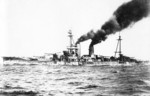 |  | 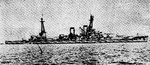 | 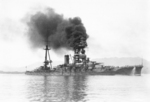 |
Ise Operational Timeline
| 1 Dec 1917 | Ise was commissioned into service. |
| 11 Mar 1942 | Shokaku and Zuikaku accompanied Vice Admiral Takasu Shiro's First Fleet (Ise and Hyuga) on a sortie to sweep for enemy believed to approaching Japan. |
| 25 Oct 1944 | Off northeastern Luzon, Philippines, aircraft from US Navy Task Force 38 attacked the Japanese carrier force consisted of fleet carrier Zuikaku and light carriers Zuiho, Chitose, and Chiyoda in the Battle off Cape Engaño. The Japanese force was escorted by two battleship-carrier hybrids (Hyuga and Ise; aircraft-less on this date), three light cruisers (Oyodo, Tama, and Isuzu), and nine destroyers at about 0830 hours, 26 minutes after those planes were detected by Zuikaku's radar. The overwhelmingly larger American force, under Admiral William Halsey, centered around fleet carriers USS Lexington, USS Intrepid, USS Essex, USS Franklin, USS Enterprise, further bolstered by a great many light carriers, battleships, cruisers, and destroyers. Zuikaku was damaged by skilled damage control teams extinguished the fires and corrected the listing by 0850 hours. Chitose was fatally damaged by the first attack wave, sinking at 0937 hours. At 0953 hours, a second attack wave struck, fatally damaging Chiyoda, leaving her dead in the water to be sunk by American destroyers later at 1655 hours. The second wave also damaged Zuiho's flight deck, the last functional flight deck of Vice Admiral Jisaburo Ozawa's force; Japanese combat air patrol planes in the air would need to ditch when they ran out of fuel. At 1032 hours, Ozawa transferred his flag from the damaged Zuikaku to Oyodo. At 1308, the Japanese sighted an incoming third wave of American aircraft. Six torpedoes struck Zuikaku, causing massive flooding and several fires in the hangar; the commanding officer addressed the surviving crew, ordered the lowering of the ensign, and gave the abandon ship order at 1358 hours; Zuikaku sank by the stern at 1414 hours. Zuiho suffered two torpedo, two bomb hits, and a great many near-misses during the third attack wave, and she was dead in the water at 1445 hours. At 1455 hours, a fourth wave struck, sealing the doom of Zuiho with ten near-misses, leading to Zuiho's commanding officer giving the abandon ship order; she sank at 1526 hours. |
| 30 Dec 1944 | Japanese convoy HI-84 sailed past battleship-carrier Ise, battleship-carrier Hyuga, cruiser Oyodo, cruiser Ashigara, destroyer Asashimo, and destroyer Kasumi in the South China Sea in the morning. At 1157 hours, HI-84 arrived at Binhoang Bay, French Indochina. |
| 24 Jul 1945 | British TF 37 launched 416 sorties, 261 of which were sent against the Japanese home islands and 155 were for defensive patrols; escort carrier Kaiyo was damaged by British carrier planes. On the same day, American TF 38 launched 600 aircraft against Kure, Nagoya, Osaka, and Miho, sinking battleship-carrier Hyuga, heavy cruiser Tone, and target ship Settsu, and damaging carrier Ryuho, carrier Amagi, battleship-carrier Ise, battleship Haruna, heavy cruiser Aoba, light cruiser Oyodo, transport Kiyokawa Maru; the Aichi aircraft factories at Nagoya were seriously damaged. |
| 28 Jul 1945 | 137 American P-47 aircraft based in Ie Shima, Okinawa, Japan attacked targest in Kyushu, Japan. On the same day, 471 B-29 bombers attacked smaller Japanese cities in the home islands with incendiary bombs. Finally, from the sea, US Navy carrier aircraft struck various Inland Sea ports between Nagoya and northern Kyushu, sinking battleship Haruna, battleship-carrier Ise, heavy cruiser Aoba (in shallow water), and light cruiser Oyodo, and damaging carrier Katsuragi, carrier Hosho, and already beached battleship Settsu. |
Please consider supporting us on Patreon. Even $1 per month will go a long way! Thank you. Please help us spread the word: Stay updated with WW2DB: |


Visitor Submitted Comments
17 Jul 2010 11:58:34 PM
CV-4 Ranger's planes did not sink Ise. Planes from VAdm.McCain's TG did. Before the WWII Adm.McCain was the CO of the Ranger. Ranger never was in the 3rd/5th Fleet
 Bill says:
27 Nov 2011 01:34:45 PM
HYBRID BATTLESHIP/CARRIER:
With the loss of four carriers at Midway the
Imperial Navy modified the Battleship Ise to
carry aircraft. The two aft turrets were removed and replaced with a hanger and a 230ft flight deck.
Aircraft carried were eleven Yokosuka D4Y2 Judy Dive-bombers and eleven Aichi E-16A Paul Seaplanes. The Judy bombers could be launched, but not recovered, they would recover aboard a conventional carrier or return to land bases.
The Paul Seaplanes could land on water and be lifted aboard for another mssion. After
WWII the Ise was broken up and scrappped.
Ise sister ship the Hyuga was also modified into a hybrid battleship/carrier, she was also scrapped at the end of the war.
THE IMPERIAL JAPANESE NAVY IN MINIATURE:
Japanese Model Companies like Hasegawa and
Fujimi produce the Imperial Japanese Navy in
1/700 scale.
Battleships, Heavy Cruisers, Light Cruisers, Aircraft Carriers, Destroyers, Transports and Support Ships.
All visitor submitted comments are opinions of those making the submissions and do not reflect views of WW2DB.

» Koga, Mineichi
» Niimi, Masaichi
» Yamaguchi, Tamon
Event(s) Participated:
» Dutch East Indies Campaign, Java
» Battle of Midway and the Aleutian Islands
» Mariana Islands Campaign
» Philippines Campaign, Phase 1, the Leyte Campaign
» Preparations for Invasion of Japan
Related Books:
» Imperial Japanese Navy Battleships 1941-45
» Warship 2009
Partner Sites Content:
» Ise Tabular Record of Movement
- » 1,182 biographies
- » 337 events
- » 45,119 timeline entries
- » 1,249 ships
- » 350 aircraft models
- » 207 vehicle models
- » 376 weapon models
- » 123 historical documents
- » 261 facilities
- » 470 book reviews
- » 28,415 photos
- » 365 maps
General Douglas MacArthur at Leyte, 17 Oct 1944

Please consider supporting us on Patreon. Even $1 a month will go a long way. Thank you!

Or, please support us by purchasing some WW2DB merchandise at TeeSpring, Thank you!
16 Feb 2007 08:00:59 PM
This battleship was sunk on 28 July, 1945 in Kure Harbor, Japan. It was sunk by Lt. Cmdr. David Johnson , flying a Curtiss SB-2C from Bombing Squadron VB-6 from the USS Hancock. For this, Lt. Cmdr. Johnson was awarded th Navy Cross.