


Hiei
| Country | Japan |
| Ship Class | Kongo-class Battleship |
| Builder | Yokosuka Naval Arsenal |
| Laid Down | 4 Nov 1911 |
| Launched | 21 Nov 1912 |
| Commissioned | 4 Aug 1914 |
| Sunk | 14 Nov 1942 |
| Displacement | 37,187 tons standard |
| Length | 728 feet |
| Beam | 101 feet |
| Draft | 32 feet |
| Machinery | Steam turbines, 4 shafts |
| Speed | 30 knots |
| Range | 10,000nm at 14 knots |
| Crew | 1,360 |
| Armament | 4x2x356mm/45cal guns, 16x152mm/50cal guns; As Built: 8x76mm 12pdr guns, 4x6.5mm machine guns, 4x2x533mm torpedo tubes; Post-1935: 8x127mm dual-purpose guns, 10x2x2.5cm Type 96 AA cannon |
| Armor | 8in belt amidships, 3in belt ends, 2.75in deck, 5-9in deck fore, 6-8in deck aft, 9in turrets, 10in conning tower |
| Aircraft | 2 operational, 0 in reserve |
Contributor: C. Peter Chen
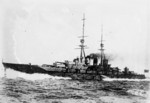
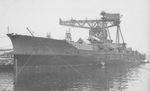
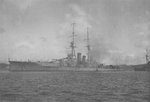
ww2dbaseThe four Kongo-class ships were the first modern warships in the Japanese Navy. They were designed by Britain's Sir George Thurston, and strongly influenced the design of the forthcoming Tiger-class battlecruisers. They were originally rated as "battlecruisers", but pre-WW2 rearmament reclassified them as battleships. Before the reclassification, she proudly served as Emperor Hirohito's flagship during the Naval Review off Yokohama in late August 1933.
ww2dbaseAfter modernization, Hiei returned to active service in early 1940 and was again the Emperor's flagship at the Yokohama Naval review in October 1940. Her high speed made her very useful as a companion to aircraft carriers, and she was part of the striking force that attacked Pearl Harbor on 7 December 1941. In April 1942, Hiei took part in the powerful raid that bloodied the British Navy and merchant marine in the Indian Ocean area. She was a unit of the Covering Group during the Battle of Midway in early June and immediately thereafter was sent to the North Pacific to support Japanese operations in the Aleutian Islands.
ww2dbaseWhen the fight over Guadalcanal began in August 1942, Hiei was sent south to operate with other units of the Combined Fleet. She was present during both of the campaign's carrier actions, the Battle of the Eastern Solomons in late August and the Battle of the Santa Cruz Islands in late October. On 12 November 1942, Hiei was ordered toward Guadalcanal as flagship of a bombardment force that included her sister fast battleship Kirishima, a light cruiser and more than a dozen destroyers. Soon after midnight on Friday, 13 November, the Japanese were met by an American task force of five cruisers and eight destroyers. The resulting first night action of the Naval Battle of Guadalcanal was chaotic and bloody. Hiei was badly shot up by U.S. cruiser and destroyer guns, and may have suffered shock damage from torpedoes exploding nearby. While retiring from the battle, her steering failed, leaving her unmaneuverable only a short distance from Guadalcanal's American-held airfield. Through the following day, Hiei's crew struggled to regain steering control, while under constant attack by U.S. aircraft. However, she finally suffered a torpedo hit in the stern that destroyed all hope of escape. Soon after nightfall, her surviving crewmen were taken off and Hiei was left to sink some miles northward of Savo Island. She was the first of ten Japanese battleships lost to enemy action in World War II.
ww2dbaseSource: Naval Historical Center
Last Major Revision: Jan 2005
Battleship Hiei Interactive Map
Photographs
 |  |  |  |
Hiei Operational Timeline
| 26 Nov 1941 | Vice Admiral Chuichi Nagumo led the Japanese Carrier Division 1 (Akagi and Kaga), Carrier Division 2 (Hiryu and Soryu), Carrier Division 5 (Shokaku and Zuikaku), first section of Battleship Division 3 (Hiei and Kirishima), Cruiser Division 8 (Tone and Chikuma), Destroyer Squadron 1, Destroyer Squadron 17, and Destroyer Squadron 18 out of Hitokappu Bay in the Kurile Islands for the Hawaii Operation, the attack on the US Pacific Fleet at Pearl Harbor, US Territory of Hawaii. |
| 1 Feb 1942 | Akagi, Kaga, Zuikaku, Hiei, Kirishima, and Chikuma departed Truk, Caroline Islands in an attempt to catch the enemy carrier force that had attacked the Marshall Islands. They were escorted by destroyers Shiranuhi, Kasumi, and Urakaze. |
| 26 Mar 1942 | Vice Admiral Chuichi Nagumo's Japanese First Air Fleet, built around a nucleus of five aircraft carriers (Akagi, Hiryu, Soryu, Shokaku, and Zuikaku), and supported by battleships (Kongo, Hiei, Haruna, and Kirishima), cruisers (Tone, Chikuma, Abukuma), and destroyers, sailed from Staring Bay, Celebes, Dutch East Indies to the west of Timor into the Indian Ocean with the intention of attacking the Royal Navy's bases at Colombo and Trincomalee in Ceylon. |
| 3 Apr 1942 | The Japanese fleet under the command of Vice Admiral Chuichi Nagumo entered the Indian Ocean. |
| 5 Apr 1942 | In the morning, Japanese carriers launched 36 D3A2 dive bombers and 53 B5N2 torpedo bombers, escorted by 36 Zero fighters, against the British naval base at Colombo, Ceylon, sinking merchant cruiser HMS Hector, damaging port facilities, while shooting down 25 British aircraft; 7 Japanese aircraft were lost in this attack. Around noon, cruiser Tone's floatplane spotted British cruisers HMS Cornwall and HMS Dorsetshire 200 miles southwest of Ceylon; 53 carrier aircraft were launched to attack, sinking Dorsetshire at 1350 hours (234 killed) and Cornwall at 1400 hours (190 killed); 1,122 survived from both ships. |
| 9 Apr 1942 | Japanese carrier aircraft attacked the harbor at Trincomalee, Ceylon at 0700 hours. Two hours later, empty British aircraft carrier HMS Hermes and Australian destroyer HMAS Vampire were detected 90 miles further south. At 1035 hours, Japanese carrier aircraft attacked and sank HMS Hermes (307 killed) and HMAS Vampire (9 killed); hospital ship Vita rescued survivors from both warships. At 1207 hours, 20 Japanese carrier dive bombers sank British oiler Athelstane (all aboard survived) and British corvette HMS Hollyhock (48 were killed, 17 survived) in the Indian Ocean. |
| 12 Nov 1942 | Destroyer Yukikaze engaged with USS Cushing and USS Laffey during the First Naval Battle of Guadalcanal, and then escorted the crippled battleship Hiei. Meanwhile, Yugure picked up Hiei survivors 5 miles northwest of Savo Island. |
| 13 Nov 1942 | Damaged in the naval battle before dawn, Hiei struggled to return to base. After persistent attacks by aircraft attacks, it was decided that she was to be scuttled. After all men were taken off, she was scuttled by torpedoes north of Savo Island in the Solomon Islands. She became the first Japanese battleship to be lost in combat. |
| 31 Jan 2019 | Research Vessel Petrel, operated by the firm Vulcan, conducted a visual inspection of a wreck under more than 3,200 feet of water. The wreck was initially discovered by sonar in 2018. The images taken by Petrel allowed researchers to positively identify the wreck as the battleship Hiei. |
Please consider supporting us on Patreon. Even $1 per month will go a long way! Thank you. Please help us spread the word: Stay updated with WW2DB: |


Visitor Submitted Comments
All visitor submitted comments are opinions of those making the submissions and do not reflect views of WW2DB.

» Abe, Hiroaki
» Arima, Masafumi
» Kusaka, Jinichi
» Ota, Minoru
Event(s) Participated:
» New Guinea-Papua Campaign, Phase 1, Bismarck Islands
» Guadalcanal Campaign
» Solomon Islands Campaign
Document(s):
» Interrogation Nav 46, Lieutenant Commander S. Yunoki
Related Books:
» Imperial Japanese Navy Battleships 1941-45
Partner Sites Content:
» Hiei Tabular Record of Movement
- » 1,176 biographies
- » 337 events
- » 44,933 timeline entries
- » 1,245 ships
- » 350 aircraft models
- » 207 vehicle models
- » 376 weapon models
- » 123 historical documents
- » 261 facilities
- » 470 book reviews
- » 28,468 photos
- » 365 maps
General Douglas MacArthur at Leyte, 17 Oct 1944

Please consider supporting us on Patreon. Even $1 a month will go a long way. Thank you!

Or, please support us by purchasing some WW2DB merchandise at TeeSpring, Thank you!
31 Mar 2021 01:40:11 AM
hiei was flagship in 1933, please add both here at top "active 1933" and on battleship page 1933. that page lacks many such year number. change launch column to active then show 1933 for hiei and same style for others. tnx.