


Kirishima
| Country | Japan |
| Ship Class | Kongo-class Battleship |
| Builder | Mitsubishi Nagasaki Shipyard |
| Laid Down | 17 Mar 1912 |
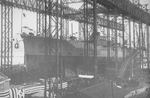
| Launched | 1 Dec 1913 |
| Commissioned | 19 Apr 1915 |
| Sunk | 15 Nov 1942 |
| Displacement | 32,156 tons standard; 36,601 tons full |
| Length | 728 feet |
| Beam | 101 feet |
| Draft | 32 feet |
| Machinery | Steam turbines, four shafts |
| Speed | 30 knots |
| Range | 10,000nm at 14 knots |
| Crew | 1,360 |
| Armament | 8x14in, 16x6in, 8x5in DP, 118x25mm anti-aircraft |
Contributor: C. Peter Chen
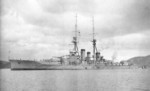
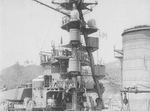
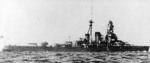
ww2dbaseThe four Kongo-class ships were the first modern warships in the Japanese Navy. They were designed by Britain's Sir George Thurston, and strongly influenced the design of the forthcoming Tiger-class battlecruisers. They were originally rated as battlecruisers, but 1933-1934 reconstruction and rearmament at Kure reclassified them as battleships.
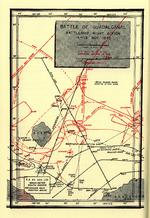
ww2dbaseAs WW2 broke out, Kirishima first served as naval support off the Chinese coast beginning in 1938, then escorted the Japanese aircraft carriers during the raid on Pearl harbor. She was active during the Japanese southward offensive in early 1942. In Mar and Apr, she was part of the powerful force that raided the British in the Indian Ocean. During the Solomons Campaign later in 1942, Kirishima was present during the carrier battles of the Eastern Solomons in August and the Santa Cruz Islands in October. She received minor damage in the night surface action off Guadalcanal on 13 Nov. Two nights later, serving as flagship of another Japanese surface force, she was engaged by the American battleships Washington and South Dakota. She exchanged gunfire with the latter, but because American destroyers' spotlights blinded Kirishima's lookouts, she could not locate Washington which was located 8,000 yards away. Because her guns were trained accurately on South Dakota already, Kirishima did not attempt to shift her guns at Washington's direction. At the end of the engagement, she was hit by nine 16-in shells and forty 5-in shells, all from Washington, and became disabled. With her superstructure aflame and rudders stuck, Kirishima was scuttled by opening her Kingston valves a few miles west of Savo Island about two and half hours after the start of the engagement. About 250 men were lost during the battle.
ww2dbaseKirishima's wreck was discovered and examined in August 1992, resting upside down with its forward end blown off some 4000 feet below the surface.
ww2dbaseSources: Interrogations of Japanese Officials, Naval Historical Center, Wikipedia.
Last Major Revision: Mar 2007
Battleship Kirishima Interactive Map
Photographs
 |  |  |  |
Maps
 |
Kirishima Operational Timeline
| 19 Apr 1915 | Kirishima was commissioned into service. |
| 21 Oct 1938 | Kirishima launched a E8N1 Type 95 floatplane and photographed HMS Birmingham off Xiamen, China. |
| 24 Aug 1942 | Kumano screened the carrier Ryujo and the battleship Kirishima in the Battle of the Eastern Solomons and against an attack from B-17 bombers. |
| 15 Nov 1942 | US battleship Washington sank Japanese battleship Kirishima by gunfire off Savo Island in the Solomon Islands. |
Did you enjoy this article or find this article helpful? If so, please consider supporting us on Patreon. Even $1 per month will go a long way! Thank you. Share this article with your friends: Stay updated with WW2DB: |


Visitor Submitted Comments
4 Jan 2019 09:48:33 AM
Washington hit Kirishima with 20-21 16inch shells; more of them were underwater hits that flooded her hull- she was not scuttled. See Combined Fleet website for documentation.
All visitor submitted comments are opinions of those making the submissions and do not reflect views of WW2DB.
» Mikawa, Gunichi
» Nagumo, Chuichi
» Sakai, Saburo
» Tokuno, Hiroshi
Event(s) Participated:
» Attack on Pearl Harbor
» Invasion of Malaya and Singapore
» New Guinea-Papua Campaign, Phase 1, Bismarck Islands
» Attack on Darwin
» Raids into the Indian Ocean
» Battle of Midway and the Aleutian Islands
» Guadalcanal Campaign
» Solomon Islands Campaign
Related Books:
» Imperial Japanese Navy Battleships 1941-45
Partner Sites Content:
» Kirishima Tabular Record of Movement
- » 1,150 biographies
- » 337 events
- » 43,918 timeline entries
- » 1,241 ships
- » 350 aircraft models
- » 207 vehicle models
- » 375 weapon models
- » 123 historical documents
- » 260 facilities
- » 470 book reviews
- » 28,563 photos
- » 432 maps
George Patton, 31 May 1944

Please consider supporting us on Patreon. Even $1 a month will go a long way. Thank you!

Or, please support us by purchasing some WW2DB merchandise at TeeSpring, Thank you!
26 Jun 2014 05:27:43 PM
Info is incorrect on American BBs that engaged the Kirishima. The BBs in question were the USS Washington (a North Carolina class ship) and the USS South Dakota that engaged and sank her.