


Conclusion of the Desert War
Contributor: C. Peter Chen
ww2dbaseAs the Axis forces were pushed to northern Tunisia, Adolf Hitler adamantly refused any consideration of evacuating the surviving forces to southern Europe, thus sealing the fate of German and Italian Desert War veterans.
ww2dbaseOperation Flax
5-27 Apr 1943
ww2dbaseAs of mid-Mar 1943, German aircraft were still able to deliver large quantities of supplies and ammunition to northern Tunisia; en route back to Italy, despite Hitler's orders, some of them helped evacuating Axis troops. On 5 Apr, German General Theo Osterkemp was appointed the commanding officer of Jagdfliegerführer Sizilien, which in part was tasked with challenging Allied airpower particularly over the waters between Tunisia and Sicily, Italy in order to maintain the supply runs by air.
ww2dbaseAllies placed James Doolittle to design Operation Flax to interfere with this supply route. At 0630 hours on 5 Apr, 26 P-38 fighters of the US 1st Fighter Group conducted a sweep over the Sicilian Strait, catching a large air fleet of 50 to 70 Ju 52 transport aircraft, 20 Bf 109 fighters, 4 Fw 190 fighters, 6 Ju 87 dive bombers, and 1 Fw 189 fighter at about 0800 hours. At the same time, 18 B-25 bombers of the US 321st Bomb Group, escorted by 32 P-38 fighters of the US 82nd Fighter Group, attacked a convoy; some of the escorting fighters joined in on the aerial interception, which was the main objective of Operation Flax. After the battle, US 1st Fighter Group pilots claimed 11 Ju 52, 2 Ju 87, 2 Bf 109, and 1 Fw 189 aircraft shot down at the cost of only 2 P-38 fighters; US 82nd Fighter Group pilots claimed 7 Ju 52, 3 Ju 87, 3 bf 109, 1 Bf 110, and 1 Me 210 shot down (some of which were escorting the naval convoy) at the cost of only 4 P-38 fighters. German reports indicated the loss of 13 or 14 Ju 52 transports and 3 fighters, which was significantly less than American reports, but still indicated a heavy loss in transports. As for the Axis naval convoy, the Americans reported 2 transports damaged and 1 destroyer sunk at the cost of 1 B-25 bomber.
ww2dbaseAlso on the same day, 5 Apr, 18 B-17 bombers of US 97th Bomb Group attacked Axis airfields at El Aounina and Sid Ahmed in Tunisia, destroying several aircraft on the ground; the bombers were escorted by both American and British fighters. 35 B-25 bombers of US 310th Bomb Group, escorted by 18 P-38 fighters of US 82nd Fighter Group, were sent to attack airfields near Borizzo, Sicily, Italy, destroying 13 German and 8 Italian aircraft on the ground while also claiming 5 fighters shot down. 72 B-17 bombers of US 99th Bomb Group attacked Bocca di Falco airfield, destroying 4 Axis aircraft on the ground and 2 fighters in the air, at the cost of two British Spitfire fighters shot down.
ww2dbaseOn 7 Apr, Jagdfliegerführer Sizilien was assigned 148 fighters; Osterkemp's counterpart in Tunisia, Hans Seidemann of Fliegerkorps Tunis, had about 300 fighters.
ww2dbaseIn the morning of 10 Apr, 75 P-38 fighters of US 1st Fighter Group intercepted 20 Italian SM.82 transports escorted by 6 C.200 fighters; 10 transports and 2 fighters would be shot down. Later that same morning, 18 B-25 bombers of US 310th Bomb Group attacked Axis positions at Cape Bon in Tunisia, escorted by 27 P-38 fighters of US 82nd Fighter Group; they spotted 32 Ju 52 transports and 3 Ju 88 bombers escorted by 2 Bf 110 and 2 Ju 87 aircraft, and moved in to attack, shooting down 10 Ju 52, 1 Ju 88, 1 Bf 109, and 1 Bf 110 aircraft (some of which were scrambled from nearby airfields to defend the Allied attack). The Germans also lost several other aircraft in smaller engagements in the area on this day.
ww2dbaseOn 11 Apr, fighters of US 82nd Fighter Group again intercepted a German air convoy consisted of 20 Ju 52, 4 Ju 88, 4 Bf 110, and 7 Bf 109 fighters; they claimed shooting down all 20 Ju 52 aircraft and 7 of the escorts. In the afternoon, another flight of 20 fighters of US 82nd Fighter Group encountered 30 unescorted Ju 52 aircraft; 5 of them were shot down at the cost of 1 P-38 fighter. On the same day, 34 British Spitfire fighters of No. 152 Squadron RAF intercepted an air convoy of about 12 Ju 52 aircraft escorted by a few Bf 109 fighters; they shot down 3 Ju 52 aircraft at the cost of 2 Spitfire fighters.
ww2dbaseOn 12 Apr, the British RAF Desert Air Force joined in on Operation Flax en force; in fact, taking over many operational command roles.
ww2dbaseIn the morning of 13 Apr, B-17 bombers of US 97th and 301st Bomb Groups attacked the airfields at Castelvetrano and Trapani, Sicily, destroying 11 Italian and 8 German aircraft and damaging 16 Italian and 40 German aircraft, at the cost of only 2 B-17 bombers. In the afternoon, British fighters raided the same airfields; 1 German Ju 88 and 1 British Spitfire aircraft were shot down.
ww2dbaseOn 16 Apr, 13 British Spitfire fighters intercepted a large Axis air convoy, shooting down 7 SM.82 and 1 Bf 109 aircraft at the cost of only 2 Spitfire fighters, one of which was Wing Commander Ian Gleed of No. 244 Wing RAF. Later on the same day, Germans launched a small counterattack consisted of 8 Fw 190 and 16 Bf 109 aircraft, attacking Allied airfields near Souk el Khemis, destroying 6 A-20 Havoc bombers.
ww2dbaseon 17 Apr, 7 B-17 bombers escorted by 40 P-38 fighters bombed Palermo, Sicily; 30 Bf 110 fighters rose to engage the bombers and 27 Bf 109 fighters against the fighters, claiming 5 bombers and 1 fighter shot down at the cost of 1 Bf 109 fighter.
ww2dbaseLate in the afternoon on 18 Apr, 47 P-40 fighters and 12 Spitfire fighters came across an air convoy consisted of 65 Ju 52 aircraft at an altitude of 1,000 feet, flying northeast, escorted by 21 fighters. As the Allies shot down many Axis aircraft, the situation grew so desperate that passengers in Ju 52 transports were reportedly firing machine guns out of windows in an attempt to help. In this action that was later dubbed Palmsontag Massaker, or "Palm Sunday Massacre", by the Germans, the Americans shot down 24 Ju 52 aircraft, 10 German fighters, and a unknown number of Italian fighters; 35 German Ju 52 aircraft returned home damaged.
ww2dbaseOn 18 Apr, South African fighters of No. 2 Squadron SAAF and No. 54 Squadron SAAF of No. 7 Wing SAAF shot down 16 Italian SM.82 aircraft.
ww2dbaseOn 22 Apr, 36 P-40 fighters of No. 7 Wing SAAF, supported by British Spitfire fighters, intercepted an Italian air convoy, claiming 12 Ju 52, 2 SM.79, 1 Ju 87, 1 Re.2001, 2 Bf 109, and 1 Ju 88 aircraft, along with a glider that was towed by the Ju 87 aircraft; the South Africans lost only 3 P-40 fighters and the British only 5 Spitfire fighters. Later in the same day, Australian, British, Polish, and South African fighters shot down 16 Me 323 transport aircraft along with 3 German and 2 Italian fighters.
ww2dbaseWith the heavy losses incurred on the German air transport fleet in Apr 1943, Hermann Göring ordered all transport runs to Tunisia to cease, continuing only after Albert Kesselring's complaint, but at a much smaller scale, and only at night. Göring would also order the evacuation of all German Air Force units to evacuate Tunisia, most of which were evacuated by 4 May, leaving only one German group (I. JG 77) and Italian aircraft to maintain air cover over North Africa.
ww2dbaseOperation Retribution
7-13 May 1943
ww2dbaseWhile Allied air forces intercepted Axis transport and evacuation flights over Tunisia and Sicily, Italy, British Admiral Andrew Cunningham conducted Operation Retribution, beginning on 7 May 1943, to blockade Tunisia to prevent any attempt to resupply or evacuate by sea. Fearful that the Italian fleet would interfere with this operation, battleship HMS Nelson, battleship HMS Rodney, and carrier HMS Formidabble were held in reserve in French Algiers, but ultimately the Italian fleet would remain in port during this period. Allied warships intercepted and sunk two transports and several small vessels during the operation.
ww2dbaseOperation Vulcan
22 Apr-13 May 1943
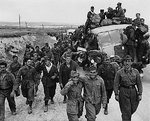
ww2dbaseThe final Allied ground offensive against Axis positions in northern Tunisia began on 22 Apr. Axis defenses were stiff and determined. German airborne troops of the Hermann Göring Division, for example, repeatedly repulsed British troops, causing heavy casualties, but ultimately the Allies would take Axis positions one by one, either overwhelming Axis defenders by force or simply fight until the defenders had run out of supplies. On 6 May, British troops captured Tunis and American troops captured Bizerte. All Axis troops in Tunisia, numbering about 240,000 at this time, surrendered on 13 May. The Allies did not know what to do with such a large influx of prisoners of war. Dwight Eisenhower noted in his memoirs in 1948 that, at the time, he exclaimed to his operations officers "[w]hy didn't some staff college ever tell us what to do with a quarter million prisoners so located at the end of a rickety railroad that it's impossible to move them and where guarding and feeding them are so difficult?" The German prisoners, despite their situation, were still neatly dressed and proud; they taunted the young American troops, threatening that if they bring the war onto continental Europe, their fellow brothers would bring the war to America. An empty threat today with perfect hindsight, but at that time, it instilled a little bit of weariness in the young American draftees.
ww2dbaseOn 15 May, Cunningham announced that "the passage through the Mediterranean was clear", and convoys from Gibraltar to Alexandria, Egypt resumed.
ww2dbaseSources:
Dwight Eisenhower, Crusade in Europe
Wikipedia
Last Major Update: Apr 2011
Conclusion of the Desert War Interactive Map
Photographs
 |  |  |  |
Conclusion of the Desert War Timeline
| 5 Apr 1943 | Allies launched Operation Flax, a concentrated effort to destroy Axis capability to supply Tunisia by air. |
| 7 Apr 1943 | German Luftwaffe assigned 148 fighters to Jagdfliegerführer Sizilien. |
| 9 Apr 1943 | British troops captured Mahares, Tunisia. |
| 10 Apr 1943 | The Allied continued Operation Flax offensives over the waters between Sicily, Italy and Tunisia, Italian North Africa, destroying many Axis transport aircraft and fighters. On the ground, British troops captured Sfax, Tunisia. |
| 11 Apr 1943 | The Germans lost several transport aircraft flying between Sicily, Italy and Tunisia, Italian North Africa. On the ground, Allied troops captured Kairouan, Tunisia. |
| 12 Apr 1943 | British RAF Desert Air Force assumed leadership roles in Operation Flax in North Africa. On the same day, troops of British 8th Army captured Sousse, Tunisia. |
| 13 Apr 1943 | US bombers attacked Italian airfields at Castelvetrano and Trapani, Sicily, Italy, destroying 11 Italian and 8 German aircraft and damaging 16 Italian and 40 German aircraft, at the cost of only 2 B-17 bombers. |
| 16 Apr 1943 | 13 British Spitfire fighters intercepted a large Axis air convoy off Tunisia, shooting down 7 SM.82 and 1 Bf 109 aircraft at the cost of only 2 Spitfire fighters. |
| 17 Apr 1943 | US bombers attacked Palermo, Sicily, Italy. German pilots who scrambled to meet the attackers claimed shooting down 5 bombers and 1 fighter. |
| 18 Apr 1943 | 47 P-40 and 12 Spitfire fighters intercepted a large Axis air convoy off Tunisia, shooting down 24 German transport aircraft, 10 German fighters, and some Italian fighters. So many lives were lost that the Germans dubbed the action Palm Sunday Massacre. |
| 20 Apr 1943 | British troops captured the Enfidaville Airfield in Tunisia. |
| 21 Apr 1943 | New Zealand troops of Maori ethnicity captured Takrouna, Tunisia. |
| 22 Apr 1943 | South African and British fighters intercepted an Italian air convoy off Tunisia, Italian North Africa and claimed to have shot down 12 transport aircraft and 7 escorts. On the ground, the final Allied assault began against the remaining Axis forces in North Africa with armoured thrusts from Sidi Nsir, Medjez, and Pont du Fahs. Only at Enfidaville was there a halt. Resistance remained fierce, however, and was professionally handled by the Germans and Italians, allowing units of the Luftwaffe to be evacuated from the shrinking perimeter. |
| 29 Apr 1943 | German troops fell back to Lake Garaet Anchkel west of Bizerte, Tunisia; "Grado" Battalion of the "San Marco" naval infantry regiment of Italian Navy served as rearguard. |
| 1 May 1943 | US troops captured Hill 609 in Tunisia. |
| 3 May 1943 | US troops captured Mateur, Tunisia. |
| 4 May 1943 | The German Luftwaffe evacuation from Tunisia, Italian North Africa completed. |
| 6 May 1943 | In Tunisia, British troops captured Tunis and American troops captured Bizerte. The German 15th Panzer Division was effectively wiped out. |
| 7 May 1943 | Allied naval forces began the Operation Retribution blockade, sealing off Tunisia, Italian North Africa from the sea. |
| 9 May 1943 | The "San Marco" naval infantry regiment of Italian Navy surrendered at Bizerte, Tunisia. |
| 10 May 1943 | The British 6th Armoured Division cut off German troops at Cape Bon, Tunisia. |
| 13 May 1943 | The remaining Axis troops surrendered in Tunisia. For the first time in the war, the British claimed more German prisoners than the number of British captives in Germany. |
| 15 May 1943 | British Admiral Andrew Cunningham announced that "the passage through the Mediterranean was clear", and convoys from Gibraltar to Alexandria, Egypt resumed. |
Please consider supporting us on Patreon. Even $1 per month will go a long way! Thank you. Please help us spread the word: Stay updated with WW2DB: |


Visitor Submitted Comments
All visitor submitted comments are opinions of those making the submissions and do not reflect views of WW2DB.
» Bennett, Donald
» Bradley, Omar
» Clark, Mark
» Cunningham, Andrew
» Doolittle, James
» Eddy, Manton
» Eisenhower, Dwight
» Kesselring, Albert
» Leese, Oliver
» Messe, Giovanni
» Montgomery, Bernard
» Osterkamp, Theodor
» Spaatz, Carl
» Tedder, Arthur
Location:
» Tunisia
Related Books:
» An Army at Dawn
» Patton, Montgomery, Rommel: Masters of War
- » 1,169 biographies
- » 337 events
- » 44,828 timeline entries
- » 1,244 ships
- » 350 aircraft models
- » 207 vehicle models
- » 376 weapon models
- » 123 historical documents
- » 261 facilities
- » 470 book reviews
- » 28,524 photos
- » 365 maps
Winston Churchill

Please consider supporting us on Patreon. Even $1 a month will go a long way. Thank you!

Or, please support us by purchasing some WW2DB merchandise at TeeSpring, Thank you!
17 May 2008 11:55:36 AM
enjoyed the article,but one question, life or look mag had a cover picture of the north african campaign any chance of finding it? thanks