


Kako
| Country | Japan |
| Ship Class | Furutaka-class Heavy Cruiser |
| Builder | Kobe |
| Launched | 10 Apr 1925 |
| Commissioned | 1 Jul 1926 |
| Sunk | 10 Aug 1942 |
| Displacement | 10,507 tons standard |
| Length | 595 feet |
| Beam | 51 feet |
| Draft | 18 feet |
| Speed | 33 knots |
| Crew | 625 |
Contributor: C. Peter Chen
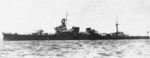
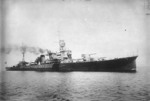
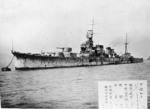
ww2dbaseKako, a 7100-ton Furutaka class heavy cruiser built at Kobe, Japan, was commissioned in July 1926. Assigned to the Fifth Squadron (Sentai) from then until 1933, she served in Japanese and Chinese waters, participating in fleet maneuvers and combat operations in China. The cruiser was given a major refit in 1929-30, improving her machinery and slightly changing her appearance. Briefly operating with Sentai 6 in 1933, Kako was present for the naval review off Yokohama in late August. She went into guard ship status in November of that year and into reserve in 1934. In July 1936, she began an extensive reconstruction at Sasebo.
ww2dbaseKako returned to service in December 1937 almost completely transformed. Her original six 200mm single gun mounts had been replaced by three twin 203mm gun turrets. She now had new anti-aircraft machine guns and torpedo tubes, improved gunfire control equipment, different boilers, a wider hull and a generally altered appearance. Reassigned to Sentai 6, she operated in Japanese home waters and off China in the years leading up to the Pacific war.
ww2dbaseWhen Japan attacked U.S. and British positions in December 1941, Kako took part in the assaults on Guam and Wake. In March and April 1942, she supported operations against New Guinea, the northern Solomon Islands and the Admiralty Islands. In early May she covered landings at Tulagi, in the southern Solomons, and escorted the carrier Shoho and the Port Moresby invasion force during the Battle of the Coral Sea on 7-8 May. After being overhauled at Kure in May and June, Kako was sent to the vicinity of the northern Solomon Islands. When U.S. Marines invaded Guadalcanal and Tulagi on 7 August 1942, she was one of seven Japanese cruisers ordered south to intervene. In the 9 August night Battle of Savo Island, these ships inflicted a serious defeat on a joint U.S.-Australian task force. While steaming toward Kavieng, New Ireland, on 10 August 1942, Kako was torpedoed and sunk by the U.S. submarine S-44 (SS-155).
ww2dbaseSource: Naval Historical Center
Last Major Revision: Jan 2005
Heavy Cruiser Kako Interactive Map
Photographs
 |  |  |  |
Kako Operational Timeline
| 1 Jul 1926 | Kako was commissioned into service. |
| 8 Aug 1942 | In the pre-dawn morning, 7 Japanese cruisers and 1 destroyer under Gunichi Mikawa departed Kavieng, New Ireland and Rabaul, New Britain, sailing south without being detected; after sundown, the force caught Allied warships by surprise off Guadalcanal in the Solomon Islands; in the Battle of Savo Island, Japanese cruisers Chōkai, Aoba, Kako, Kinugasa, and Furutaka used Type 93 torpedoes and gunfire to sink US cruisers USS Quincy, Vincennes, and Astoria and Australian cruiser HMAS Canberra; 1,077 US personnel were killed in this battle (Canberra was badly damaged and was ultimately scuttled by a US destroyer). |
| 10 Aug 1942 | USS S-44 spotted a group of four Japanese heavy cruisers at the distance of 800 meters about 90 miles east of Kavieng, New Ireland at 0750 hours. At 0806 hours, she fired four Mark 10 torpedoes, scoring three hits on heavy cruiser Kako. Kako sank at about 0815 hours; 34 were killed, 582 survived. |
Please consider supporting us on Patreon. Even $1 per month will go a long way! Thank you. Please help us spread the word: Stay updated with WW2DB: |


» Kondo, Nobutake
Event(s) Participated:
» Battle of Coral Sea
» Guadalcanal Campaign
Partner Sites Content:
» Kako Tabular Record of Movement
- » 1,150 biographies
- » 337 events
- » 44,163 timeline entries
- » 1,243 ships
- » 350 aircraft models
- » 207 vehicle models
- » 375 weapon models
- » 123 historical documents
- » 260 facilities
- » 470 book reviews
- » 28,654 photos
- » 431 maps
Thomas Dodd, late 1945

Please consider supporting us on Patreon. Even $1 a month will go a long way. Thank you!

Or, please support us by purchasing some WW2DB merchandise at TeeSpring, Thank you!