


Aoba
| Country | Japan |
| Ship Class | Furutaka-class Heavy Cruiser |
| Launched | 25 Sep 1926 |
| Commissioned | 1 Sep 1927 |
| Sunk | 28 Jul 1945 |
| Displacement | 10,822 tons standard |
| Length | 595 feet |
| Beam | 57 feet |
| Draft | 18 feet |
| Speed | 33 knots |
| Crew | 625 |
Contributor: C. Peter Chen
ww2dbaseAoba, first of a class of two 8300-ton heavy cruisers, was built at Nagasaki, Japan. Commissioned in September 1927, she was assigned to Fifth Squadron (Sentai) until 1933 and thereafter to the Sixth and Seventh Squadrons, serving as their flagship during much of her career. In addition to participation in the Japanese Navy's operational exercises, she frequently served in Chinese waters in the late 1920s and the 1930s during that nation's ordeals with domestic violence and foreign intervention.
ww2dbaseThe cruiser was modernized at Sasebo between 1938 and 1940, receiving new torpedo tubes, an enhanced anti-aircraft gun battery, improved gunfire controls and better aircraft handling facilities. Her bridge structure was rebuilt and bulges added to her hull to compensate for the associated weight increases and improve her stability. After recommissioning in October 1940, Aoba served with the Sixth Squadron during its pre-World War II operations in Japanese, Chinese and central Pacific waters. Soon after war began in December 1941, she took part in the capture of Guam and Wake. In May 1942 she participated in the Battle of the Coral Sea.
ww2dbaseDuring the Guadalcanal campaign that began in August 1942, Aoba was heavily engaged with Allied sea and air forces, participating in the the 9 August Battle of Savo Island and the Battle of Cape Esperance on 13 October. She was seriously damaged by U.S. warship gunfire in the latter action, which took the lives of nearly eighty of those on board, including the Sixth Squadron's commander, Rear Admiral Aritomo Goto.
ww2dbaseAfter repairs, Aoba returned to the south Pacific war zone in February 1943, only to be hit by air attack on 3 April. The badly damaged ship was out of action until December 1943, when she was assigned to the East Indies area. Kept busy for the next ten months carrying supplies and maintaining readiness for offensive operations, she was en route to participate in the Battle of Leyte Gulf on 23 October 1944 when the U.S. submarine Bream (SS-243) hit her amidships with a torpedo. Though further damaged by bombs in October, Aoba was able to reach Japan in mid-December.
ww2dbaseAoba remained at or near Kure, Japan for the rest of the Pacific War, being used only as a floating anti-aircraft battery. In attacks by U.S. carrier planes and Air Force bombers on 24 and 28 July 1945, she was hit several times and sunk in shallow water. Her wreck was scrapped in 1946-47.
ww2dbaseSource: Naval Historical Center
Last Major Revision: Jan 2005
Heavy Cruiser Aoba Interactive Map
Photographs
 | 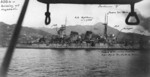 | 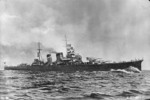 | 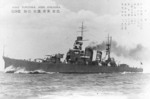 |
Aoba Operational Timeline
| 25 Sep 1926 | Aoba was launched at Nagasaki, Japan. |
| 1 Sep 1927 | Aoba was commissioned into service. |
| 8 Aug 1942 | In the pre-dawn morning, 7 Japanese cruisers and 1 destroyer under Gunichi Mikawa departed Kavieng, New Ireland and Rabaul, New Britain, sailing south without being detected; after sundown, the force caught Allied warships by surprise off Guadalcanal in the Solomon Islands; in the Battle of Savo Island, Japanese cruisers Chōkai, Aoba, Kako, Kinugasa, and Furutaka used Type 93 torpedoes and gunfire to sink US cruisers USS Quincy, Vincennes, and Astoria and Australian cruiser HMAS Canberra; 1,077 US personnel were killed in this battle (Canberra was badly damaged and was ultimately scuttled by a US destroyer). |
| 24 Jul 1945 | British TF 37 launched 416 sorties, 261 of which were sent against the Japanese home islands and 155 were for defensive patrols; escort carrier Kaiyo was damaged by British carrier planes. On the same day, American TF 38 launched 600 aircraft against Kure, Nagoya, Osaka, and Miho, sinking battleship-carrier Hyuga, heavy cruiser Tone, and target ship Settsu, and damaging carrier Ryuho, carrier Amagi, battleship-carrier Ise, battleship Haruna, heavy cruiser Aoba, light cruiser Oyodo, transport Kiyokawa Maru; the Aichi aircraft factories at Nagoya were seriously damaged. |
| 28 Jul 1945 | 137 American P-47 aircraft based in Ie Shima, Okinawa, Japan attacked targest in Kyushu, Japan. On the same day, 471 B-29 bombers attacked smaller Japanese cities in the home islands with incendiary bombs. Finally, from the sea, US Navy carrier aircraft struck various Inland Sea ports between Nagoya and northern Kyushu, sinking battleship Haruna, battleship-carrier Ise, heavy cruiser Aoba (in shallow water), and light cruiser Oyodo, and damaging carrier Katsuragi, carrier Hosho, and already beached battleship Settsu. |
Did you enjoy this article or find this article helpful? If so, please consider supporting us on Patreon. Even $1 per month will go a long way! Thank you. Share this article with your friends: Stay updated with WW2DB: |


Visitor Submitted Comments
 C. Peter Chen says:
23 Jul 2014 07:18:14 AM
Keith, thank you very much for pointing out the date discrepancy. It has been fixed now.
All visitor submitted comments are opinions of those making the submissions and do not reflect views of WW2DB.
» Koga, Mineichi
Event(s) Participated:
» Invasion of Guam
» Dutch East Indies Campaign, Java
» Guadalcanal Campaign
» Preparations for Invasion of Japan
Partner Sites Content:
» Aoba Tabular Record of Movement
- » 1,150 biographies
- » 337 events
- » 43,917 timeline entries
- » 1,241 ships
- » 350 aircraft models
- » 207 vehicle models
- » 374 weapon models
- » 123 historical documents
- » 260 facilities
- » 470 book reviews
- » 28,543 photos
- » 432 maps
General Douglas MacArthur at Leyte, 17 Oct 1944

Please consider supporting us on Patreon. Even $1 a month will go a long way. Thank you!

Or, please support us by purchasing some WW2DB merchandise at TeeSpring, Thank you!
23 Jul 2014 06:41:16 AM
Your sinking date on heavy cruiser Aoba differs from the bio. The bio lists her sunk between 24 and 28 August 1945, and the other area lists her sunk 28 July 1942