


Yubari
| Country | Japan |
| Ship Class | Yubari-class Light Cruiser |
| Builder | Sasebo Naval Arsenal |
| Launched | 5 Mar 1923 |
| Commissioned | 31 Jul 1923 |
| Sunk | 28 Apr 1944 |
| Displacement | 3,141 tons standard; 3,587 tons full |
| Length | 450 feet |
| Beam | 39 feet |
| Draft | 11 feet |
| Speed | 35 knots |
Contributor: C. Peter Chen
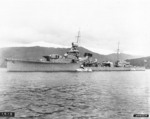
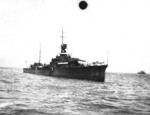
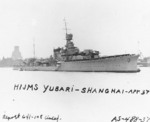
ww2dbaseYubari, a 3141-ton light cruiser of innovative design, was built at Sasebo, Japan. Commissioned at the end of July 1923, she was generally employed as flagship for destroyer squadrons. In the years before World War II, she made frequent cruises to China in that capacity and on independent missions or in company with other light cruisers. In 1925, she steamed through the western Pacific and visited Australia. Yubari saw combat action against Chinese shore batteries in 1932. She visited Java in 1937 and patrolled off China after war began with that nation later in the year. Assigned to the central Pacific in 1941 as a destroyer squadron flagship, she was there when Japan attacked the United States in December.
ww2dbaseYubari's initial World War II combat operation was the attempt to capture Wake on 10-11 December 1941. Though that attack was repulsed, she participated in the capture of the island base later in the month. During January-March 1942, Yubari helped seize Allied positions in the New Britain and New Guinea area, but was damaged by U.S. carrier plane attacks during the Lae-Salamaua operation on 10 March. She was repaired in time to serve as flagship of the Port Moresby Attack Force during the Battle of the Coral Sea in May and later supported the Japanese buildup on Guadalcanal. When the Allies landed on Guadalcanal and Tulagi in August, Yubari was sent south with other cruisers to counter-attack, an assignment that led to victory against U.S. and Australian warships in the 9 August 1942 Battle of Savo Island. Later in August, she covered landings at Nauru and Ocean Islands and spent the following three months on escort and patrol duties.
ww2dbaseAfter overhaul, the cruiser returned to the south Pacific in April 1943. Yubari led destroyers in a bombardment of the U.S. invasion beaches at Rendova in early July, and was damaged by a mine on the 5th of that month, requiring her to return to Japan for repairs. She was back in the south Pacific combat zone from October to December 1943, and was slightly damaged by U.S. carrier planes off Rabaul on 11 November. Yubari was refitted in December 1943 - March 1944, receiving enhanced anti-aircraft firepower at the expense of two of her heavier guns, and was then sent to the central Pacific. After completing a transport mission to Sonsorol Island on 27 April 1944, she was hit by a torpedo from the U.S. submarine Bluegill (SS-242). Efforts to control progressive flooding were unsuccessful, and Yubari sank the following morning.
Last Major Revision: Jan 2005
Photographs
 |  |  |  |
Yubari Operational Timeline
| 31 Jul 1923 | Yubari was commissioned into service. |
| 5 Sep 1937 | Yubari and Destroyer Squadron 5 was ordered to blockade the coast of Guangdong, China. |
| 14 Sep 1937 | Japanese cruiser Yubari and two destroyers engaged with Chinese cruiser Zhaohe and sloop Haizhou off the Pearl River Delta off Guangdong, China. Zhaohe and Haizhou were both damaged, and the captain of Zhaohe would later be shot for ordering a retreat from this engagement. |
| 11 Dec 1941 | The 2,890-ton Japanese light cruiser Yubari, flagship of Rear Admiral Sadamichi Kajioka, was seriously damaged by shell fire from two 5-inch guns at Peacock Point, Wake Island, and forced to retire listing heavily to port. |
Did you enjoy this article or find this article helpful? If so, please consider supporting us on Patreon. Even $1 per month will go a long way! Thank you. Share this article with your friends: Stay updated with WW2DB: |


» Daigo, Tadashige
Event(s) Participated:
» Battle of Wake Island
» Battle of Coral Sea
» Guadalcanal Campaign
Partner Sites Content:
» Yubari Tabular Record of Movement
- » 1,150 biographies
- » 337 events
- » 43,917 timeline entries
- » 1,241 ships
- » 350 aircraft models
- » 207 vehicle models
- » 374 weapon models
- » 123 historical documents
- » 260 facilities
- » 470 book reviews
- » 28,543 photos
- » 432 maps
Joachim von Ribbentrop, German Foreign Minister, Aug 1939

Please consider supporting us on Patreon. Even $1 a month will go a long way. Thank you!

Or, please support us by purchasing some WW2DB merchandise at TeeSpring, Thank you!