1910 | 1911 | 1912 | 1913 | 1914 | 1915 | 1916 | 1917 | 1918 | 1919
1920 | 1921 | 1922 | 1923 | 1924 | 1925 | 1926 | 1927 | 1928 | 1929
1930 | 1931 | 1932 | 1933 | 1934 | 1935 | 1936 | 1937 | 1938 | 1939
1940 | 1941 | 1942 | 1943 | 1944 | 1945 | 1946 | 1947 | 1948 | 1949
1 Jan 1934
- Germany passed the "Law for the Prevention of Genetically Diseased Offspring". ww2dbase [CPC]
- Georg von Bismarck was promoted to the rank of Major. ww2dbase [Georg von Bismarck | CPC]
- Brummer was commissioned into service. ww2dbase [Brummer | CPC]
France
- The French Air Force placed an order for 30 examples of MB.200 bombers. ww2dbase [MB.200 | CPC]
Germany
- Robert von Greim was promoted to the rank of Major. ww2dbase [Robert von Greim | CPC]
- Nordseewerke Emden Werft und Dock Aktiengesellschaft in Emden, Germany reopened after nearly 3 years of inactivity. ww2dbase [Nordseewerke Emden | Emden | AG]
Libya
- Italo Balbo was named the Governor-General of Italian Libya. ww2dbase [CPC]
5 Jan 1934
Ukraine
- The keel of submarine ShCh-205 was laid down at the Shipyard Named After 61 Communards at Nikolaev, Ukraine. ww2dbase [ShCh-205 | Nikolaev | CPC]
13 Jan 1934
China
- Tang Enbo's 10th Column captured Fuzhou, Fujian Province, China from communist forces. ww2dbase [Tang Enbo | Fuzhou, Fujian | CPC]
15 Jan 1934
Russia
- Boris Shaposhnikov was awarded his first Order of the Red Star. ww2dbase [Boris Shaposhnikov | CPC]
20 Jan 1934
- In Germany, the "Law for the ordering of National Labour" (drafted by the mayor of Leipzig, and future resistance leader, Carl Goerdeler) was established. This gave German managers absolute power to impose wage levels, monitor and discipline the workforce and in some industries restrict the right of employees to change their employment. ww2dbase [AC]
22 Jan 1934
Taiwan
- Major General Sumei Kuwaki was named the chief of staff of the Taiwan Army. ww2dbase [CPC]
30 Jan 1934
- The Reichsrat (the second chamber of the German government) was abolished by the Law for the Reconstruction of the Reich. At the same time all provincial parliaments lost their right to draft local legislation. ww2dbase [AC]
31 Jan 1934
China
- Chinese artifacts and treasures (19,557 pieces in total, packed in 6,066 crates, transported in five groups) began to be relocated from the Exhibition Office of Ancient Artifacts, the Yiheyuan, and the Hanlin Yuan Imperial Academy in the Beiping area for Shanghai due to the threat of Japanese aggression. ww2dbase [Beiping | CPC]
1 Feb 1934
- Werner Mölders was promoted to the rank of Oberfähnrich. ww2dbase [Werner Mölders | CPC]
- Ernst Röhm suggested to the Reich Defence Council that his SA should take over all defence duties and that the German Army be relegated to the task of training his men. ww2dbase [AC]
United States
- Bryant Boatner was promoted to the rank of first lieutenant. ww2dbase [Bryant Boatner | CPC]
2 Feb 1934
2 Feb 1934 Photos
6 Feb 1934
- Werner Mölders began receiving basic flying instructions at the Deutsche Verkehrsfliegerschule in Cottbus, Germany. ww2dbase [Werner Mölders | CPC]
China
- Han Chinese and Muslim Chinese forces captured Kashgar, Xinjiang, China after defeating the 10,000-strong Khotanlik Uyghur separatist garrison. ww2dbase [Xinjiang Wars | Kashgar, Xinjiang | CPC]
7 Feb 1934
Japan
- Kichisaburo Nomura was awarded the Grand Cordon of the Order of the Rising Sun. ww2dbase [Kichisaburo Nomura | CPC]
7 Feb 1934 Photos
8 Feb 1934
8 Feb 1934 Photos
9 Feb 1934
- President Roosevelt suspended all civil airmail contracts (effective from 19 Feb 1934) and handed the role over to the United States Army Air Corps. ww2dbase [Franklin Roosevelt | AC]
10 Feb 1934
Philippines
- USS Stewart suffered a small fire aboard while undergoing overhaul work at Cavite Navy Yard in the Philippines. ww2dbase [Stewart | Cavite | CPC]
11 Feb 1934
- Roger Backhouse was promoted to the rank of admiral. ww2dbase [Roger Backhouse | CPC]
12 Feb 1934
- The four-day-long Austrian Civil War began. ww2dbase [CPC]
United Kingdom
- HMS Neptune was commissioned into service. ww2dbase [Neptune | AC]
15 Feb 1934
- Adolf Galland joined the Luftwaffe; he would complete basic military training at Dresden, Germany. ww2dbase [Adolf Galland | AC]
United States
16 Feb 1934
- In Germany the "Cinema Act" added additional restrictions to the content of allowable entertainment. ww2dbase [AC]
Newfoundland
- The parliament of Newfoundland relinquished self-government and turned control of the dominion back to the United Kingdom. ww2dbase [CPC]
16 Feb 1934 Photos
17 Feb 1934
- A new German law gave the Nazi Party Courts (introduced by Hitler as early as 1921) full judicial status with the right to investigate and punish petty misdemeanours by NSDAP members (e.g. Failure to pay dues, immoral behaviour, a criminal record or simply loss of interest in Party affairs). ww2dbase [AC]
- King Albert I of Belgium died in a mountaineering accident. He would be succeeded by his son, Prince Leopold. ww2dbase [Leopold III | AC]
21 Feb 1934
Germany
- German President Paul von Hindenburg approved the wearing of Nazi badges by German soldiers. ww2dbase [AC]
22 Feb 1934
Poland
- Approval for the production of the Polish TK-3 tankette was granted. ww2dbase [TKS | CPC]
23 Feb 1934
- Leopold III became the King of Belgium. ww2dbase [Leopold III | CPC]
23 Feb 1934 Photos
25 Feb 1934
Germany
- The order for the German army to commence wearing Nazi party badges was published in Militär-Wochenblatt No. 32. ww2dbase [AC]
25 Feb 1934 Photos
27 Feb 1934
- The "Law for the Organic Reconstruction of Germany's Economic System" established a national structure of chambers under Albert Pietzsch's Reich Economic Chamber (Reichswirtschaftskammer). All previous economic associations were abolished to be replaced by six national chambers representing industry, commerce, handicraft, banking, insurance and energy supply. ww2dbase [AC]
28 Feb 1934
Germany
- At a conference in the Great Hall of the Army General Staff Building on Bendlerstrasse, Berlin, Germany, Hitler told the assembled senior Army and SA officers in no uncertain terms that the Army would be the sole bearer of arms, although for the time being the SA would continue its frontier protection duties and paramilitary training. In addition Hitler informed the delegates that the Army must be organized to carry out training to be ready for a defensive war in five years and a war of aggression in eight years. ww2dbase [Adolf Hitler | Berlin | AC]
1 Mar 1934
- Werner Mölders was promoted to the rank of Leutnant; he also transferred to the Luftwaffe on this date. ww2dbase [Werner Mölders | CPC]
- George Patton was promoted to the permanent rank of lieutenant colonel. ww2dbase [George Patton | CPC]
China
- Zhang Jinghui, already the head of the Ministry of Defense of the puppet state of Manchukuo since 1932, was named the Minister of Defense. ww2dbase [Zhang Jinghui | Changchun, Jilin | CPC]
- As the Manchukuo Department of Finance was reformed as the Finance Ministry, Xi Qia was named its first minister. ww2dbase [Xi Qia | Changchun, Jilin | CPC]
1 Mar 1934 Photos
5 Mar 1934
China
- Juzo Nishio was named the chief of staff of Takashi Hishikari (Japanese Kwantung Army in northeastern China). ww2dbase [CPC]
Japan
- Hiroshi Nemoto was givern responsibility of the production of munitions in Japan. ww2dbase [Hiroshi Nemoto | CPC]
United Kingdom
- The order for the construction of destroyer Garland was issued to the Fairfield Shipbuilding and Engineering of Scotland, United Kingdom. ww2dbase [Garland | CPC]
6 Mar 1934
6 Mar 1934 Photos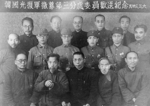
7 Mar 1934
7 Mar 1934 Photos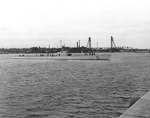
20 Mar 1934
French Indochina
- Emperor Bao Dai married Marie-Thérèse Nguyen Huu Thi Lan, a commonor from a wealthy Vietnamese family, in the Imperial City in Hue, Annam, French Indochina. She was renamed Nam Phuong upon the marriage. ww2dbase [Bao Dai | Hue, Annam | CPC]
21 Mar 1934
- In Germany an emergency decree made it an offence to spread malicious gossip, spread defeatist of demoralizing comments, make defamatory remarks about political figures or the Nazi Party, or utter remarks likely to cause "foreign policy difficulties". ww2dbase [AC]
- The Nazi German regime reintroduced Sondergerichte Courts, special courts without the usual safeguards in legal procedure, to deal with political cases. ww2dbase [AC]
24 Mar 1934
- The Philippine Commonwealth was established. ww2dbase [CPC]
27 Mar 1934
- The United States Navy authorized the contract to build the Sargo-class submarine Spearfish. ww2dbase [Spearfish | DS]
27 Mar 1934 Photos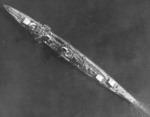
28 Mar 1934
Germany
- The German Prussian ministry warned of the consequences of allowing children in Rhineland of mix heritage to reproduce; these children were mostly offsprings of German women and African occupation soldiers. In 1937, these children would be among those arrested by the Gestapo and sterilized. ww2dbase [CPC]
United Kingdom
- The British Naval Board suggested that HMS Phaeton, currently under construction, should be transferred to Australia to replace the aging cruiser HMAS Brisbane. It was recommended that the ship was to be renamed HMAS Sydney. ww2dbase [Sydney | CPC]
29 Mar 1934
Germany
- Germany published its defence estimates which were increased by one-third and include an increase of 250% for the Luftwaffe. ww2dbase [AC]
30 Mar 1934
United Kingdom
- The 833-ton British steam coastal merchant ship Jim struck a mine a sank two miles south east of Aldburgh on the Suffolk coast, England, United Kingdom. Six of her crew were killed. ww2dbase [Aldburgh, England | HM]
31 Mar 1934
- Submarine tender Taigei was commissioned into service. ww2dbase [Ryuho | CPC]
1 Apr 1934
- Wilhelm Keitel was promoted to the rank of Generalmajor. ww2dbase [Wilhelm Keitel | CPC]
- Rudolf Höss was accepted into the SS organization and was given the rank of SS-Mann. ww2dbase [Rudolf Höss | CPC]
- Kurt Fricke was promoted to the rank of frigate captain. ww2dbase [Kurt Frike | CPC]
Germany
- The Hamburgischer Correspondent, a German newspaper that had been in print since 1710, was dissolved by the Nazi German government; its assets were acquired by the publisher Hermanns Erben. ww2dbase [CPC]
- Germany formed the Hanseatische Fliegerschule e. V. air unit based at Fassberg, Germany. ww2dbase [Fassberg | CPC]
- Georg von Küchler was promoted to the rank of major general. ww2dbase [Georg von Küchler | CPC]
Russia
- Nikolai Kamanin, in a R-5 biplane, completed the flight from Olyutorka, Koryak Okrug, Russia to the village of Vankarem in Chukotka Okrug, Russia. ww2dbase [Nikolai Kamanin | Olyutorka, Koryak | CPC]
2 Apr 1934
Japan
- Chiaki Matsuda was appointed to the Army General Staff as a naval liaison officer. ww2dbase [Chiaki Matsuda | Tokyo | CPC]
5 Apr 1934
- Kuniaki Koiso was awarded the Order of the Rising Sun, 1st Class. ww2dbase [Kuniaki Koiso | CPC]
Japan
- Japanese cruiser Kumano laid down at Kawasaki's shipyard, Kobe. ww2dbase [Kumano | Kobe, Hyogo | DS]
11 Apr 1934
- The pocket battleship Deutschland sailed from Kiel, Germany as a part of the spring manoeuvres. On board were Hitler and his leading army and navy commanders. It was thought that during the voyage Minister of Defence Blomberg nominated Hitler as a candidate for the Presidency (and thus making him Supreme Commander of the Army). ww2dbase [Deutschland | AC]
12 Apr 1934
- German justice department issued orders to prevent "improper usage of protective custody" to prevent those who did not deserve to be sent to concentration camps from being sent there; this ruling remained valid until 1938. ww2dbase [Discovery of Concentration Camps and the Holocaust | CPC]
China
- Chiang Kaishek stepped down as the commandant of the Chinese Central Aviation Academy at Jianqio Airfield, Hangzhou, Zhejiang Province, China, handing the resonsibility over to Lieutenant General Zhou Zhirou. ww2dbase [Jianqiao Airfield | Chiang Kaishek | Hangzhou, Zhejiang | CPC]
14 Apr 1934
Russia
- Nikolai Kamanin was made one of the first Heroes of the Soviet Union for his effort in the rescue of the survivors of the steamship Chelyuskin. ww2dbase [Nikolai Kamanin | CPC]
16 Apr 1934
China
- Chinese 36th Division captured Yangi Hissar, Xinjiang, China, killing all surviving Uyghur defenders of the originally 500-strong garrison. Khotanlik separate leader Emir Nur Ahmad Jan Bughra was captured and executed. ww2dbase [Xinjiang Wars | Yangi Hissar, Xinjiang | CPC]
Germany
17 Apr 1934
- The Fairey Swordfish Torpedo bomber took flight for the first time. ww2dbase [Swordfish | AC]
- Ilmarinen was commissioned into service. ww2dbase [Ilmarinen | CPC]
18 Apr 1934
- Japan requested western powers to stay out of China. ww2dbase [CPC]
20 Apr 1934
- Rudolf Höss was promoted to the rank of SS-Sturmmann. ww2dbase [Rudolf Höss | CPC]
Germany
- Hermann Göring transferred control of the Gestapo secret police organization to Heinrich Himmler. ww2dbase [Heinrich Himmler | CPC]
- Heinrich Himmler appointed Reinhard Heydrich the head of Gestapo in Prussia, Germany. ww2dbase [Reinhard Heydrich | CPC]
United Kingdom
- The British Cabinet approved the 28 Mar 1934 proposal from the Naval Board, which suggested the transfer of HMS Phaeton, currently under construction, to Australia as HMAS Sydney. ww2dbase [Sydney | CPC]
21 Apr 1934
21 Apr 1934 Photos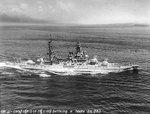
24 Apr 1934
Germany
- In Germany, a Supreme Court was created in Berlin to take on the most serious cases of treason. ww2dbase [Berlin | AC]
24 Apr 1934 Photos
25 Apr 1934
25 Apr 1934 Photos
28 Apr 1934
United States
29 Apr 1934
- Kuniaki Koiso was awarded the Order of the Sacred Treasure, 1st Class and the Order of the Golden Kite, 2nd Class. ww2dbase [Kuniaki Koiso | CPC]
Japan
- Prince Hiroyasu was awarde Collar of the Supreme Order of the Chrysanthemum. ww2dbase [Hiroyasu | CPC]
- Kichisaburo Nomura was awarded the Order of the Golden Kite Second Class. ww2dbase [Kichisaburo Nomura | CPC]
- Kenkichi Ueda was awarded Grand Cordon of the Order of the Rising Sun (1st Class) and Order of the Golden Kite 3rd Class. ww2dbase [Kenkichi Ueda | CPC]
30 Apr 1934
- Bernhard Rust was named the Minister of Science, Education and National Culture (Reichserziehungsminister) of Germany. ww2dbase [Bernhard Rust | CPC]
1 May 1934
- During this month, SS leader Theodor Eicke was given the task by Heinrich Himmler to reorganize all concentration camps, using Eicke's former direct responsiblity, Dachu Concentration Camp, as a model. ww2dbase [Discovery of Concentration Camps and the Holocaust | CPC]
1 May 1934 Photos
3 May 1934
- Tatsuta Maru arrived at Honolulu, US Territory of Hawaii. ww2dbase [Tatsuta Maru | CPC]
4 May 1934
4 May 1934 Photos
5 May 1934
Russia
- The Hero of the Soviet Union award was established by the Central Executive Committee of the Soviet Union. ww2dbase [CPC]
9 May 1934
- Lieutenant Commander John Boyd Mallard was made the commanding officer of USS Stewart. ww2dbase [Stewart | CPC]
United States
15 May 1934
- In Germany, the "Unified Theatre Law" gave the Reich Chamber of Culture the right to dictate the content of what could be performed. ww2dbase [AC]
- Germany banned workers from changing jobs without official authorization. ww2dbase [CPC]
17 May 1934
Germany
- The order for fleet escort ship F1 was placed. ww2dbase [F1 | CPC]
- The order for fleet escort ship F2 was placed. ww2dbase [F2 | CPC]
- The order for fleet escort ship F3 was placed. ww2dbase [F3 | CPC]
- The order for fleet escort ship F4 was placed. ww2dbase [F4 | CPC]
- The order for fleet escort ship F5 was placed. ww2dbase [F5 | CPC]
- The order for fleet escort ship F6 was placed. ww2dbase [F6 | CPC]
- The order for fleet escort ship F7 was placed. ww2dbase [F7 | CPC]
- The order for fleet escort ship F8 was placed. ww2dbase [F8 | CPC]
19 May 1934
- Minneapolis was commissioned into service. ww2dbase [Minneapolis | CPC]
Bulgaria
- A military coup d'état in Bulgaria seized power and abolished political parties. King Boris III was reduced to the status of a puppet king, but within a year he would lead a successful counter coup that would overthrow the military leaders. ww2dbase [Boris III | AC]
23 May 1934
United States
- Bank robbers Bonnie Parker and Clyde Barrow were killed in a shoot out in Bienville Parish, Louisiana, United States. ww2dbase [Bienville Parish, Louisiana | AC]
25 May 1934
Japan
- Captain Toru Izawa was named the commanding officer of Tenryu. ww2dbase [Tenryu | CPC]
29 May 1934
29 May 1934 Photos
30 May 1934
- Rejecting the authority of the new Reich Bishop, representatives of almost half of the Evangelical Churches in Germany met at Barmen in Westphalia where they declared a break-away Confessing Church (Bekenntniskirche) founded upon a theological declaration drafted by Karl Barth and two other young clergymen in a hotel room in Frankfurt-am-Main a few days before. ww2dbase [AC]
1 Jun 1934
- Bernhard Rust officially assumed his position as the Minister of Science, Education and National Culture (Reichserziehungsminister) of Germany. ww2dbase [Bernhard Rust | CPC]
France
- The first AMR 33 light tanks were delivered to the French Army. ww2dbase [AMR 33 | CPC]
Japan
- Mutsu was assigned to the Yokosuka Naval District, Japan. ww2dbase [Mutsu | Yokosuka, Kanagawa | CPC]
- Kamoi completed its conversion from an oiler to a seaplane carrier and was assigned to the 3rd Carrier Division. ww2dbase [Kamoi | CPC]
4 Jun 1934
Germany
- In a four-hour meeting German Chancellor Adolf Hitler instructed SA leader Ernsrt Röhm to send the 4,500,000 men of the SA on leave for the month of Jul 1934 and Röhm himself to take sick leave for a few weeks. ww2dbase [Adolf Hitler | AC]
United States
- America's fourth aircraft carrier, USS Ranger, was commissioned at Norfolk, Virginia, United States under the command of Captain Arthur L. Bristol. Although smaller than the USS Lexington and USS Saratoga, Ranger was the first US carrier to be designed and built as such from the keel up. Ranger, which cost $20,000,000 to build, incorporated many design features that led to the more functional vessels of World War II. ww2dbase [Norfolk Navy Yard | Ranger | Norfolk, Virginia | AC]
5 Jun 1934
Japan
- As the flagship of Rear Admiral Wang Shouting, with a training crew, Ninghai arrived at Yokohama, Japan to attend the funeral of Admiral Heihachiro Togo. Upon the completion of the funeral, she set sail for Harima, Japan for an overhaul. ww2dbase [Ninghai | Yokohama, Kanagawa | CPC]
6 Jun 1934
Belgium
- Prince Albert (later King Albert II) of Belgium was born at Stuyvenberg Castle on the outskirts of Brussels, Belgium. ww2dbase [Brussels | AC]
7 Jun 1934
- Nazi Party SA leader Ernst Röhm went on leave upon learning of a potential political attack on him. ww2dbase [CPC]
United Kingdom
- At a large British Union of Fascists rally, attended by 15,000 people who had come to hear Oswald Mosley speak, including some 2,000 Blackshirts acting as stewards, at the Olympia Stadium in London, England, United Kingdom a couple of thousand communist infiltrators heckled to the point where open mass brawling broke out when hecklers were removed by the stewards. This resulted in such bad publicity that the party lost support from many of its influential supporters, who defected away in protest of Mosley's ever more radical and authoritarian methods. ww2dbase [Oswald Mosley | London, England | AC]
7 Jun 1934 Photos
8 Jun 1934
- Cuttlefish was commissioned into service. ww2dbase [Cuttlefish | CPC]
9 Jun 1934
- Cruiser Köln began gunnery drills with pocket battleship Deutschland. ww2dbase [Köln | CPC]
10 Jun 1934
10 Jun 1934 Photos
11 Jun 1934
Germany
- Rudolf Höss participated in a new SS members' gathering and inspection at Stettin, Germany (now Szczecin, Poland). He met with Heinrich Himmler, an old passing acquaintance, who asked him to transfer from his original task of raising horses for the SS to a new position in the concentration camps system. ww2dbase [Rudolf Höss | Stettin, Pommern | CPC]
12 Jun 1934
Mediterranean Sea
- HMS Acasta accidentally collided with 3rd Destroyer Flotilla leader HMS Codrington during an exercise off Malta; she was sent to port for repairs. ww2dbase [Acasta | CPC]
13 Jun 1934
- Adolf Hitler and Mussolini met in Venice, Italy; Mussolini later described the German dictator as "a silly little monkey". ww2dbase [Adolf Hitler | CPC]
14 Jun 1934
14 Jun 1934 Photos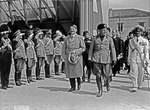
17 Jun 1934
- Vice-Chancellor von Papen made a speech at Marburg University in Germany in which he protested about the Nazi control of the press and warning against further radicalism. The Nazi leaders meanwhile were spending that Sunday with the Führer, Hitler, at a conference in Thuringia, Germany, and to them Papen's speech sounded like a rallying call for counter-revolution. Publication of the speech was banned by Goebbels, who was a main target of much of Papen's criticism. ww2dbase [Franz von Papen | AC]
18 Jun 1934
- Farragut was commissioned into service. ww2dbase [Farragut | CPC]
19 Jun 1934
19 Jun 1934 Photos
20 Jun 1934
- German Vice Chancellor Franz von Papen complained to President Paul von Hindenburg of the censoring of his 17 Jun 1934 speech by the Nazi Party, threatening to resign if nothing would be done to improve the situation. ww2dbase [Franz von Papen | CPC]
21 Jun 1934
- German President Paul von Hindenburg, with Minister of War Werner von Blomberg at his side, met with Adolf Hitler. Hindenburg told Hitler to back down politically, or he would declare martial law, which would remove powers from Hitler, giving them to the military instead. ww2dbase [Adolf Hitler | CPC]
United States
- The first aircraft landed aboard USS Ranger at Hampton Roads, Virginia, a Vought O3U-2 Corsair scout plane flown by Lt Cmdr. Arthur C. Davis with Chief Aviation Machinist Mate H. E. Wallace as observer. ww2dbase [Ranger | Hampton Roads, Virginia | DS]
21 Jun 1934 Photos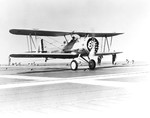
22 Jun 1934
- Ferdinand Porsche agreed to embark on Hitler's Volkswagen project. ww2dbase [CPC]
22 Jun 1934 Photos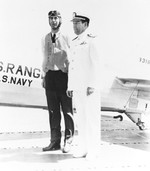
25 Jun 1934
Germany
- German Army General Werner von Fritsch put the army on alert based on the intelligence of a possible putsch by the Nazi Party SA organization. ww2dbase [Werner von Fritsch | CPC]
26 Jun 1934
United States
- The keel of destroyer Cummings was laid down at the United Shipyards facility in Staten Island, New York, United States. ww2dbase [Cummings | Staten Island, New York | CPC]
27 Jun 1934
Germany
- Sepp Dietrich requested the German Reichwehr authorities for arms so that the Liebstandarte could carry out what he called "a secret and most important mission ordered by the Führer" (ie. the slaughter of dissident elements within the SA). ww2dbase [Josef Dietrich | AC]
28 Jun 1934
- Cruiser Köln completed gunnery drills with pocket battleship Deutschland. ww2dbase [Köln | CPC]
- Ernst Röhm was relieved of his position as the leader of the Nazi Party SA organization. ww2dbase [CPC]
Germany
- Generalleutnant Ewald von Kleist, the German Army Commander in the Silesia region, was alarmed to discover from a local SA commander that both SS and SA units were arming for an attack on each other. ww2dbase [Paul von Kleist | AC]
29 Jun 1934
- Adolf Hitler visited Nazi Party camps in Westphalia, Germany. ww2dbase [Adolf Hitler | CPC]
Germany
- Generalleutnant Ewald von Kleis flew to Berlin, Germany to warn General Werner von Fritsch of the impending violence between the SS and SA organizations of the Nazi Party. When Fritsch informed Walther von Reichenau at the Defence Ministry the latter simply replied that it was "too late now". ww2dbase [Paul von Kleist | Berlin | AC]
30 Jun 1934
- "Night of the Long Knives" began a week of murder and political purging throughout Germany. ww2dbase [TH]
- Admiral Graf Spee was launched. ww2dbase [Admiral Graf Spee | CPC]
Germany
30 Jun 1934 Photos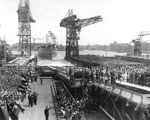
1 Jul 1934
Germany
- On Adolf Hitler's orders, Ernst Röhm, the head of the SA, was shot in a cell at Stadelheim prison in München (Munich), Germany by Theodor Eicke, the SS Commandant of the local Dachau Concentration Camp. ww2dbase [München, München-Oberbayern | AC]
2 Jul 1934
- German President Paul von Hindenburg expressed appreciation for Adolf Hitler's decisiveness in executing the measures to put down the putsch by the Nazi Party SA organization before it took shape. ww2dbase [Adolf Hitler | CPC]
3 Jul 1934
- At a German cabinet meeting a law was agreed that murder without trial was lawful if done for the defence of the state. ww2dbase [AC]
France
- The French Army issued an order for 92 AMR 35 light tanks. ww2dbase [AMR 35 | CPC]
Germany
- In his Order of the Day, German Minister of War Werner von Blomberg praised Adolf Hitler's soldierly decision and the exemplary courage used to wipe out traitors and mutineers of the Nazi Party SA organization. ww2dbase [Werner von Blomberg | CPC, AC]
9 Jul 1934
9 Jul 1934 Photos
10 Jul 1934
Russia
- Viktor Abakumov was assigned to the Economic Department of the GUGB of the Soviet NKVD. ww2dbase [Viktor Abakumov | CPC]
12 Jul 1934
Germany
- Hermann Göring, the German Reichstag President, announced that Adolf Hitler was above the law. ww2dbase [Hermann Göring | AC]
United States
- Submarine USS Narwhal departed San Diego, California on a cruise with Submarine Division 12 off the west coast of the United States. ww2dbase [Narwhal | San Diego, California | DS]
13 Jul 1934
Germany
- Adolf Hitler claimed to the German Reichstag that the Night of the Long Knives massacres were justified as the Nazi Party SA organization was planning a putsch. Although Hitler presented no concrete evidence, the Reichstag accepted the claim, thus legalizing the murders. ww2dbase [Adolf Hitler | AC]
14 Jul 1934
China
- USS Stewart collided with a Chinese warship at Yantai, Shandong Province, China, causing minor damage. ww2dbase [Stewart | Yantai, Shandong | CPC]
United States
20 Jul 1934
- The British Government proposed the expansion of the RAF by 41 squadrons over the next five years. It was considered to be an unnecessary and panic measure by both the Labour and Liberal Parties and was censured by both. ww2dbase [AC]
Germany
- The order for the construction of U-12 was issued. ww2dbase [U-12 | CPC]
22 Jul 1934
United States
- The outlaw, John Dillinger, was slain in a murderous FBI ambush outside a cinema in Chicago, Illinois, United States. ww2dbase [Chicago, Illinois | AC]
23 Jul 1934
Russia
- The keel of ShCh-317 was laid down at Shipyard 194 named after A. Marti in Leningrad, Russia. ww2dbase [ShCh-317 | Leningrad | CPC]
25 Jul 1934
- Austrian Chancellor Engelbert Dollfuß was assassinated by members of the Nazi Party. ww2dbase [TH]
26 Jul 1934
Germany
- The SS became an independent organization of the Nazi Party; its chief, Heinrich Himmler, would report directly to Adolf Hitler. ww2dbase [Heinrich Himmler | CPC]
26 Jul 1934 Photos
27 Jul 1934
- The repairs for damages suffered by HMS Acasta during an accidental collision in Jun 1934 were completed. ww2dbase [Acasta | CPC]
30 Jul 1934
Philippines
- A constitutional convention was convened in Manila, Philippine Islands to establish the Filipino constitution. ww2dbase [CPC]
30 Jul 1934 Photos
31 Jul 1934
Japan
- I-68 was commissioned into service. ww2dbase [I-68/I-168 | CPC]
1 Aug 1934
- Yoshijiro Umezu was promoted to the rank of lieutenant general. ww2dbase [Yoshijiro Umezu | CPC]
China
- The Central Aviation Academy began a basic flight training program at Nanchang Airfield, Nanchang Jiangxi Province, China. ww2dbase [Jianqiao Airfield | Hangzhou, Zhejiang | CPC]
Japan
- Hiroshi Nemoto was promoted to the rank of colonel. ww2dbase [Hiroshi Nemoto | CPC]
- Korechika Anami was made the Commandant of the Tokyo Military Preparatory School in Tokyo, Japan. ww2dbase [Korechika Anami | Tokyo | CPC]
Korea
- General Kenkichi Ueda was named the commanding officer of the Japanese Chosen Army in occupied Korea, relieving Yoshiyuki Kawashima. ww2dbase [Kenkichi Ueda | CPC]
- Kenkichi Ueda was made the commanding officer of the Japanese Chosen Army in Korea. ww2dbase [Kenkichi Ueda | CPC]
Russia
- ShCh-307 was launched by Baltiyskiy Zavod at Leningrad, Russia. ww2dbase [ShCh-307 | Leningrad | CPC]
- Viktor Abakumov was assigned to GULAG department of the Soviet NKVD. ww2dbase [Viktor Abakumov | CPC]
Taiwan
- Hisaichi Terauchi was named the commanding officer of the Taiwan Army. ww2dbase [Hisaichi Terauchi | CPC]
2 Aug 1934
- German President Paul von Hindenburg died; Hitler seized dictatorial powers as Führer, which was the combination of president, chancellor, and chief of armed forces. ww2dbase [CPC]
- Hitler changed the military oath so that German servicemen now swore allegiance to Hitler rather than the country. ww2dbase [Adolf Hitler | CPC]
Germany
2 Aug 1934 Photos
7 Aug 1934
7 Aug 1934 Photos
8 Aug 1934
Germany
- Per orders given by Adolf Hitler six days prior, the German Wehrmacht swore a personal oath of loyalty to Hitler rather than to the country. ww2dbase [Adolf Hitler | AC]
United Kingdom
15 Aug 1934
- Oskar von Hindenburg, son of the recently deceased German President Paul von Hindenburg, falsely proclaimed that it was his father's wish to have Adolf Hiter succeeded him as the President of Germany. ww2dbase [Adolf Hitler | CPC]
- Captain G. Fraser was named the commanding officer of HMS Hermes, relieving Captain W. B. Mackenzie. ww2dbase [Hermes | CPC]
17 Aug 1934
- Tuscaloosa was commissioned into service. ww2dbase [Tuscaloosa | CPC]
Germany
- The construction of escort ship F10 was ordered. ww2dbase [F10 | CPC]
United States
19 Aug 1934
- Hitler officially became the Führer und Reichskanzler of Germany. ww2dbase [Adolf Hitler | TH]
22 Aug 1934
Germany
United Kingdom
- The keel of Garland was laid down by the Fairfield Shipbuilding and Engineering in Govan, Scotland, United Kingdom. ww2dbase [Garland | Govan, Scotland | CPC]
24 Aug 1934
Germany
- The construction of escort ship F9 was ordered. ww2dbase [F9 | CPC]
28 Aug 1934
28 Aug 1934 Photos
4 Sep 1934
Germany
United Kingdom
- Hawker submitted the "F.36/34 Single-Seat Fighter-High Speed Monoplane" design to the British Air Ministry. ww2dbase [Hurricane | CPC]
5 Sep 1934
Japan
5 Sep 1934 Photos
6 Sep 1934
Germany
6 Sep 1934 Photos
7 Sep 1934
Germany
7 Sep 1934 Photos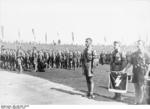
8 Sep 1934
8 Sep 1934 Photos
9 Sep 1934
Germany
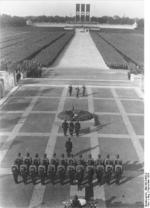
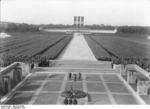
- Adolf Hitler reviewed a SA formation at the 4th Nazi Party rally in Nürnberg, Germany; in light of the recent purge of the SA, the SS placed a very heavy guard around Hitler's reviewing stand, but the parade would be uneventful. ww2dbase [Adolf Hitler | Nürnberg, Franken | CPC]
9 Sep 1934 Photos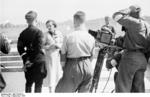
10 Sep 1934
Germany
- After a mock battle conducted by the German Army, the 4th Nazi Party rally at Nürnberg, Germany at the end of the day. ww2dbase [Nürnberg, Franken | CPC]
United States
10 Sep 1934 Photos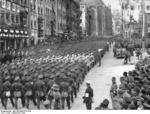
11 Sep 1934
11 Sep 1934 Photos
12 Sep 1934
- The prototype of Gloster Gladiator (K5200), the RAFs last biplane fighter, took flight for the first time. ww2dbase [Gladiator | AC]
15 Sep 1934
France
- Algérie was commissioned into service. ww2dbase [Algérie | CPC]
United States
- USS New Mexico departed the east coast of the United States for San Pedro, California, United States. ww2dbase [New Mexico | CPC]
16 Sep 1934
- Lutherans protested against the Nazi Party in Munich, Germany. ww2dbase [CPC]
18 Sep 1934
France
United States
- Submarine USS Narwhal and Submarine Division 12 arrived at San Diego, California after a cruise off the west coast of the United States. ww2dbase [Narwhal | San Diego, California | DS]
22 Sep 1934
- Sir Alan Cobham attempted to make a non-stop flight from England to India in an Airspeed As 5 Courier (G-ABXN). The flight relied upon in-flight refueling by Sir Alan's two Handley Page W.10 aircraft over Portsmouth, England, United Kingdom and Malta, and by RAF tankers at Aboukir, Egypt and Basra, Iraq. The fuel transfers were successfully completed off Selsey Bill in England and over Halfar aerodrome in Malta, but soon after this a disconnected throttle control forced Sir Alan to make an emergency landing at Halfar, where the record-breaking attempt was abandoned. ww2dbase [AC]
Germany
United Kingdom
- HMS Phaeton was launched at Wallsend on Tyne, England, United Kingdom, sponsored by Mrs. Ethel Bruce, the wife of the High Commissioner of Australia to the United Kingdom Stanley Bruce. ww2dbase [Sydney | Wallsend, England | CPC]
24 Sep 1934
Germany
- Tsingtau was commisioned into service. ww2dbase [Tsingtau | CPC]
24 Sep 1934 Photos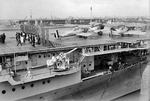
25 Sep 1934
French Indochina
- British Major General Douglas Gracey criticized Japanese troops under the command of Field Marshal Hisaichi Terauchi for failing to protect Europeans civilians in the Cité Héraud district in Saigon, Cochinchina, French Indochina in the previous night, during which an unidentified group of Vietnamese killed, raped, and tortured somewhere between 100 and 300 Europeans. Gracey threatened Terauchi with prosecutions of war crimes, while ordering additional British, French, and Japanese troops to patrol the city. Later in the day, in support of the sentiments of the unidentified attacks in the previous night, various Vietnamese groups called for boycotts against European businesses, raised roadblocks in the suburbs of Saigon, and seized control of a power plant (which would be re-captured by British troops within hours) to further protest against the British-French administration. Future French Commissioner Admiral Thierry d'Argenlieu would cite this incident as the main catalyst for the start of the Indochinese War. ww2dbase [Saigon, Cochinchina | CPC]
26 Sep 1934
United Kingdom
- RMS Queen Mary was launched at Clydebank, Scotland, United Kingdom. The Queen Mary would play a vital role in the war; transporting hundreds of thousands of Allied troops across the world's oceans. ww2dbase [Queen Mary | Clydebank, Scotland | AC]
United States
29 Sep 1934
Germany
- Emden was recommissioned into service, with Karl Dönitz in command. ww2dbase [Emden | CPC]
30 Sep 1934
- Erwin Rommel met Adolf Hitler for the first time. ww2dbase [Erwin Rommel | CPC]
- Reich Minister of Economics Hjalmar Schacht reported to Adolf Hitler on his progress of planning the German economy for war. ww2dbase [CPC]
30 Sep 1934 Photos
1 Oct 1934
- Georg von Bismarck became the commanding officer of a motorized reconnissance unit. ww2dbase [Georg von Bismarck | CPC]
- Adolf Galland was commissioned Leutnant, and was posted to Fighter Instructor JFS (fighter pilots school), Schleissheim, Germany. ww2dbase [Adolf Galland | AC]
- Wolfgang Falck was promoted to the rank of Leutnant and was retired from the German Army for transfer to the secret German air force. ww2dbase [Wolfgang Falck | CPC]
Germany
- Walter Dornberger was given command of a powder rocket training battery at Königsbrück, Germany. ww2dbase [Walter Dornberger | Königsbrück, Sachsen | CPC]
- Albatros was made the flagship of 2nd Torpedo Boat Half-Flotilla based in Swinemünde, Germany (now Swinoujscie, Poland). ww2dbase [Albatros | Swinemünde, Pommern | CPC]
United States
3 Oct 1934
Spain
- The Fascists of Gil Robles entered the Spanish government sparking four days of violence by the workers in Barcelona and Asturias. ww2dbase [AC]
4 Oct 1934
United States
- After visiting ports of Rio de Janeiro, Brazil, Buenos Aires, Argentina, and Montevideo, Uruguay, USS Ranger returned from her shakedown cruise to Norfolk, Virginia. ww2dbase [Norfolk Navy Yard | Ranger | Norfolk, Virginia | DS]
5 Oct 1934
Spain
- In Spain, about 200 mine workers from Mieres, a small and dismal village twenty miles south of Oviedo, armed with revolvers and dynamite, formed the first company of this resistance movement. Three companies of soldiers and policemen were sent against them but, after several hours of fighting, the better armed government troops were beaten. The news of this stirred up a widespread anti-government rebellion throughout the Asturias region in northern Spain. ww2dbase [Mieres, Asturias | AC]
6 Oct 1934
Spain
- In Barcelona, Spain, the Catalan Nationalist leaders proclaimed the establishment of the Catalan Republic from the balcony of the Generalidad but refrained from turning the 10,000 armed police against the workers' militias. ww2dbase [Barcelona | AC]
United States
- Northrop Corporation delivered the militarized 2C variant of the Gamma aircraft design to the US Army Air Corps for evaluation. ww2dbase [A-17 | CPC]
11 Oct 1934
United States
15 Oct 1934
- Erwin Rommel was posted to the Infantry School at Potsdam, Germany as an instructor. ww2dbase [Erwin Rommel | CPC]
15 Oct 1934 Photos
16 Oct 1934
- Chinese communists began the Long March. ww2dbase [CPC]
United States
18 Oct 1934
United States
- Joseph Rochefort received a perfect fitness report from his commanding officer. ww2dbase [Joseph Rochefort | CPC]
20 Oct 1934
20 Oct 1934 Photos
23 Oct 1934
- Italian pilot Francesco Agelio set a new world speed record of 440.682 mph (709.209 km/h) in a Macchi MC 72 racing seaplane. Remarkably this still remains the unbeaten speed record for piston-engined seaplanes. ww2dbase [AC]
27 Oct 1934
- Arturo Riccardi was made Grand Officer of the Order of the Crown of Italy. ww2dbase [Arturo Riccardi | CPC]
1 Nov 1934
- Cruiser Köln began two months of repairs at Wilhelmshaven, Germany. ww2dbase [Köln | CPC]
Hungary
- Károly Beregfy was promoted to the rank of colonel. ww2dbase [Károly Beregfy | CPC]
Korea
Taiwan
- Rear Admiral Tsuyoshi Kobata was named the Chief of Staff of the Mako naval port at Pescadores islands, Taiwan. ww2dbase [Mako Guard District | Mako, Hoko | CPC]
United States
- James Gavin was promoted to the rank of first lieutenant. ww2dbase [James Gavin | CPC]
3 Nov 1934
Germany
- Tsingtau completed her trials and was attached to the 1st Fast Attack Craft Flotilla. ww2dbase [Tsingtau | CPC]
6 Nov 1934
Ukraine
- Submarine ShCh-205 was launched at the Shipyard Named After 61 Communards at Nikolaev, Ukraine. ww2dbase [ShCh-205 | Nikolaev | CPC]
9 Nov 1934
China
- Chiang kaishek arrived at Hebian Village, Wutai County, Shanxi Province, Qing Dynasty China. ww2dbase [Chiang Kaishek | Hebian, Shanxi | CPC]
Germany
- Horst Böhme was promoted to the rank of SS-Obersturmführer. ww2dbase [Horst Böhme | CPC]
12 Nov 1934
- Admiral Scheer was commissioned into service. ww2dbase [Admiral Scheer | CPC]
Germany
13 Nov 1934
Germany
- Nazi Party Christians held a rally at the Sportpalast in Berlin, Germany, during which party officially announced what amounted to the Nazification of Christianity. ww2dbase [Berlin | CPC]
15 Nov 1934
- Captain Chuichi Nagumo was named the commanding officer of the battleship Yamashiro. ww2dbase [Yamashiro | CPC]
- Isoroku Yamamoto was promoted to the rank of vice admiral. ww2dbase [Isoroku Yamamoto | CPC]
- Hiroaki Abe was transferred out of Japanese Navy Destroyer Division 23. ww2dbase [Hiroaki Abe | CPC]
- Chuichi Nagumo was named the commanding officer of battleship Yamashiro. ww2dbase [Chuichi Nagumo | CPC]
- Captain Masanao Tanba was made the commanding officer of Kamoi. ww2dbase [Kamoi | CPC]
China
- Vice Admiral Kichijiro Hamada succeeded Vice Admiral Yurikazu Edahara as the commanding officer of the Ryojun Military Port (previously known as Port Arthur; now Lushunkou, Liaoning Province, China), Kwantung Leased Territory in northeastern China. ww2dbase [Ryojun Guard District | Lushunkou, Liaoning | CPC]
Japan
- Captain Kasuke Abe was named the commanding officer of Naka. ww2dbase [Naka | CPC]
- Captain Sueaki Kasuga was named the commanding officer of Tenryu. ww2dbase [Tenryu | CPC]
- Masafumi Arima was transferred out of Cruiser Division 7. ww2dbase [Masafumi Arima | CPC]
- Captain Marquis Teruhisa Komatsu was named the commanding officer of Nachi. ww2dbase [Nachi | CPC]
- Chiaki Matsuda was assigned to the second division of the Naval General Staff. ww2dbase [Chiaki Matsuda | Tokyo | CPC]
Korea
Taiwan
- Vice Admiral Hiroshi Ono was named the commanding officer of the Mako naval port at Pescadores islands, Taiwan. ww2dbase [Mako Guard District | Mako, Hoko | CPC]
16 Nov 1934
- Emperor Showa visited the Nakajima aircraft plant at Ota, Gunma Prefecture, Japan. ww2dbase [Showa | CPC]
17 Nov 1934
Ukraine
- The first manufacturing drawing of the fuselage of the later-christened Hurricane fighter was completed. ww2dbase [ | CPC]
18 Nov 1934
United Kingdom
23 Nov 1934
- The Dornier Do 17 twin-engine light bomber took flight for the first time. ww2dbase [Do 17 | AC]
Danzig
- Nazi Party member Arthur Greiser became the President of the Senate of Danzig. ww2dbase [CPC]
27 Nov 1934
China
- Jiang Dingwen was named the director of the anti-corruption office of Fujian Province, China. ww2dbase [Jiang Dingwen | CPC]
28 Nov 1934
- Rudolf Höss was promoted to the rank of SS-Unterscharführer. ww2dbase [Rudolf Höss | CPC]
Japan
- Kenkichi Ueda was promoted to the rank of general. ww2dbase [Kenkichi Ueda | CPC]
United Kingdom
- Winston Churchill warned the House of Commons that should Britain be attacked by hostile forces from the air, as many as 40,000 Londoners would be lost in the first week of war. ww2dbase [Winston Churchill | London, England | CPC]
1 Dec 1934
- British Air Ministry issued a contract to Supermarine for monoplane fighters powered by the Rolls-Royce PV 12 Merlin engines; they would later be named Spitfire. ww2dbase [Spitfire | CPC]
- Sergei Kirov, the popular Secretary of the Leningrad Communist Party, was assassinated by Leonid Nikolaev, an unemployed Party member, as he walked to his office in the Smolny Institute. ww2dbase [AC]
Germany
3 Dec 1934
- The Soviet Politburo approved a new law drafted by Stalin following Kirov's assassination. The new law provided that acts of terrorism were to be investigated for no more than ten days; that there would be no prosecution or defence attorneys; no appeals; and sentences of those convicted of terrorist acts were to be carried out within twenty-four hours. Whilst torture of prisoners was not officially sanctioned by the law, the interrogators were generally free to mistreat their prisoners in order to extract confessions. ww2dbase [AC]
4 Dec 1934
Russia
- The keel of submarine ShCh-313 was laid down by Baltiyskiy Zavod at Leningrad, Russia. ww2dbase [ShCh-401 | Leningrad | CPC]
5 Dec 1934
- Representatives of Italy and Ethiopia disputed over the prior month's border incident at Walwal. ww2dbase [Invasion of Ethiopia | CPC]
10 Dec 1934
- All concentration camps in Germany were transferred under the Inspekteur der KL (Inspector for Concentration Camps, or IKL), who was a part of the SS organization; the only exception was the Kislau Concentration Camp, which remained under the Interior Ministry of Baden. ww2dbase [Discovery of Concentration Camps and the Holocaust | CPC]
China
- General Jiro Minami succeeded General Takashi Hishikari as the Governor-General of Kwantung Leased Territory and the commanding officer of the Japanese Kwantung Army in northeastern China. ww2dbase [Jiro Minami | CPC]
15 Dec 1934
Japan
- Masafumi Arima became a naval logistics instructor. ww2dbase [Masafumi Arima | CPC]
17 Dec 1934
France
- The first production example of GL-832 HY floatplane took its first flight. ww2dbase [GL-832 HY | CPC]
18 Dec 1934
Germany
- Walther von Brauchitsch was awarded the Honour Cross of the World War 1914/1918. ww2dbase [Walther von Brauchitsch | CPC]
United Kingdom
- Hawker Aviation furnished further engine data to its manufacturing engineers. ww2dbase [Hurricane | CPC]
20 Dec 1934
- In Germany a new law, "Law against malicious slander of state and party and to protect party uniforms", allowed for the arrest of anyone wearing uniforms without permission or making fun of them. ww2dbase [AC]
22 Dec 1934
Japan
- Zang Shiyi visited Emperor Showa in Tokyo, Japan. ww2dbase [Zang Shiyi | Tokyo | CPC]
24 Dec 1934
24 Dec 1934 Photos

25 Dec 1934
- Philippe Leclerc was promoted to the rank of captain. ww2dbase [Philippe Leclerc | CPC]
29 Dec 1934
Germany
- Karl von Le Suire was awarded the Honor Cross of the World War 1914-1918. ww2dbase [Karl von Le Suire | CPC]
31 Dec 1934
- Werner Mölders completed basic flying training at the Deutsche Verkehrsfliegerschule in Cottbus, Germany. ww2dbase [Werner Mölders | CPC]
Russia
- The keel of submarine ShCh-324 was laid down by the Krasnoye Sormovo Factory No. 112 named after Andrei Zhdanov at Gorkiy, Russia. ww2dbase [ShCh-324 | Gorkiy | CPC]
- The keel of ShCh-320 was laid down at A. Marti shipyard (Yard 194) at Leningrad, Russia. ww2dbase [ShCh-320 | Leningrad | CPC]
United States
- The US War Department authorised the creation of a General Headquarters for the Army Air Corps, to be effective from 1 Mar 1935. Brigadier-General Frank M. Andrews was to head this new organisation at Langley Field, Virginia, with three tactical wings based at Langley, Barksdale (Louisiana) and March (California) Fields. The US Army's aviation branch thereby gained increased influence at planning levels as Andrews became a member of the General Staff. ww2dbase [AC]